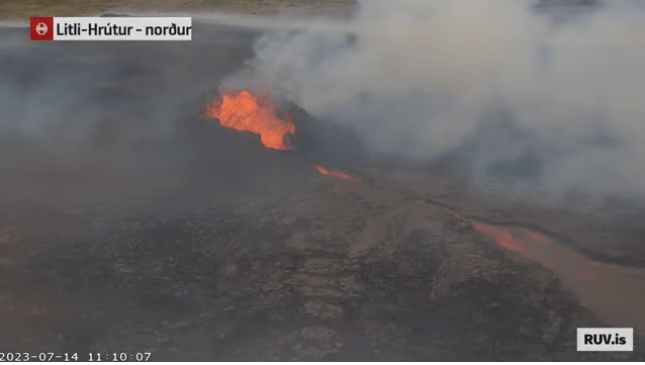
The eruption site is closed to the public right now due to the danger from volcanic gasses and smoke from moss fires; some visitors have been affected. Also, some visitors have been taking insane risks (e.g., attempting to climb the crater wall). High winds yesterday also caused issues.
The Institute of Earth Sciences, Iceland, have provided an update on the eruption here: Volcanic eruption at Litli-Hrút, measurement results 13 July | Institute of Earth Sciences (hi.is) . This is summarised below.
- As we know the eruption started on 10th July 2023 at 16:40 with the opening of four fissures with a combined length of c.800m in a north easterly direction from Litli Hrútur towards Keilir. The eruption peaked at c.21:00, diminishing to form a single crater c. 400m northeast of Litli Hrútur.
- Lava is flowing south with an average flow rate of 13m3/s (similar to the 2021 eruption) for the period 11 July to 13 July. As of 13 July 13:38, the lava volume is c. 3.4 million cubic metres covering an area of 0.4km2. Calculations were performed by NLSI from Pleiades satellite images.
- The lava composed of vesicular glass, microphenocrysts and microlites of plagioclase, olivine, clinopyroxene and spinel, similar to the 2022 lava. Lava is estimated to have a temperature of c.1190°C. The chemical composition is similar to that of the 2021 and 2022 eruptions: MgO wt.% = 8.5, and, K2O/Ti2O = 0.26.
- The gas composition is similar to that of the 2022 eruption, with a high concentration of CO2. The CO2 may have accumulated prior to the eruption. SO2 gas emissions range from 5.4-11.5 ktonnes / day and CO2 is 7.1 – 15 5 ktonnes / day.
If lava continues to flow southwards, it may reach the 2022 lavas in Meradalir.
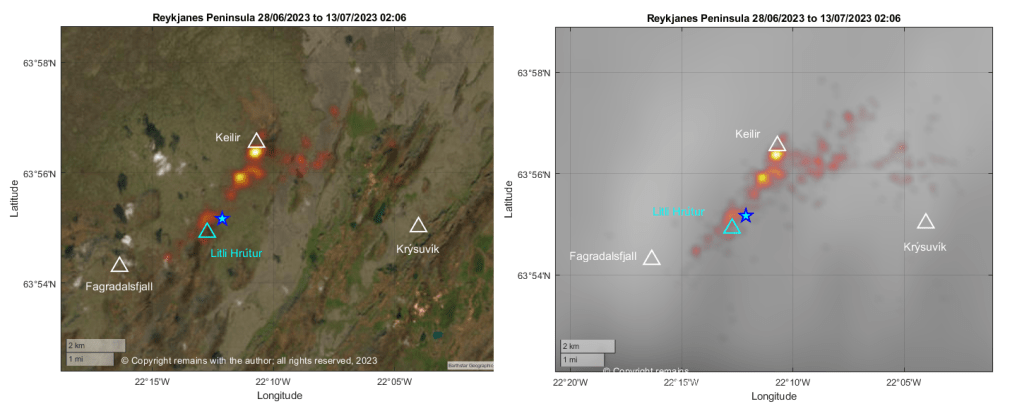
We have updated our earthquake plots to 13th July 2023 02:06, focussing more on the area between Fagradalsfjall, Keilir and Krýsuvík.
The earthquake density plot is still showing most activity southwest of Keilir and close to the eruption site, which we determined from eyeballing the location of the crater. The area southeast of Keilir is also showing more activity. Whether the activity close to Keilir is triggered quakes, the result of faults moving to accommodate the magma intrusion, or magma-related (or, indeed, both) remains to be seen.
Armchair Volcanologist
© Copyright remains with the author; all rights reserved, 2023
Sources
Raw earthquake data: Skjálfta-Lísa (vedur.is)
Other sources are included in the text.
 An Armchair Volcanologist