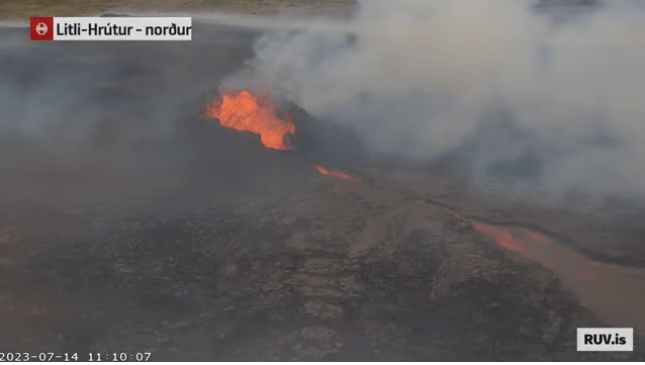
The eruption site is closed to the public right now due to the danger from volcanic gasses and smoke from moss fires; some visitors have been affected. Also, some visitors have been taking insane risks (e.g., attempting to climb the crater wall). High winds yesterday also caused issues.
As we know the eruption started on 10th July 2023 at 16:40 with the opening of four fissures with a combined length of c.800m in a north easterly direction from Litli Hrútur towards Keilir. The eruption peaked at c.21:00, diminishing to form a single crater c. 400m northeast of Litli Hrútur.
Lava is flowing south with an average flow rate of 13m3/s (similar to the 2021 eruption) for the period 11 July to 13 July. As of 13 July 13:38, the lava volume is c. 3.4 million cubic metres covering an area of 0.4km2. Calculations were performed by NLSI from Pleiades satellite images.
The lava composed of vesicular glass, microphenocrysts and microlites of plagioclase, olivine, clinopyroxene and spinel, similar to the 2022 lava. Lava is estimated to have a temperature of c.1190°C. The chemical composition is similar to that of the 2021 and 2022 eruptions: MgO wt.% = 8.5, and, K2O/Ti2O = 0.26.
The gas composition is similar to that of the 2022 eruption, with a high concentration of CO2. The CO2 may have accumulated prior to the eruption. SO2 gas emissions range from 5.4-11.5 ktonnes / day and CO2 is 7.1 – 15 5 ktonnes / day.
If lava continues to flow southwards, it may reach the 2022 lavas in Meradalir.
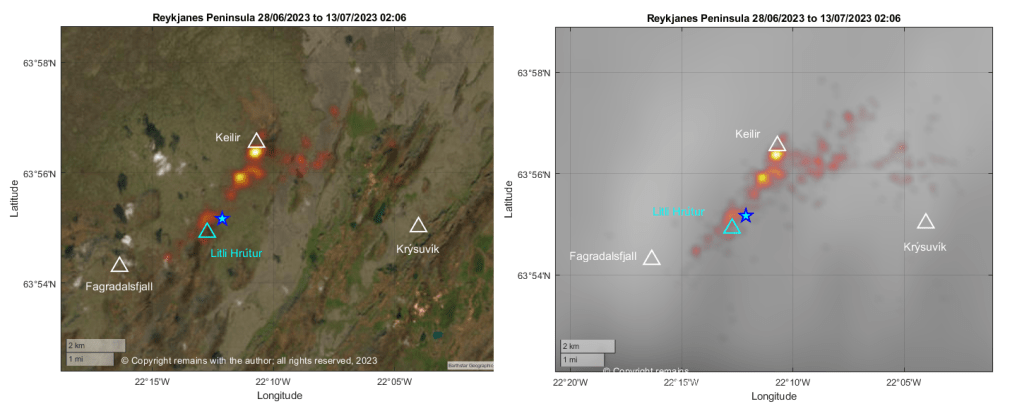
We have updated our earthquake plots to 13th July 2023 02:06, focussing more on the area between Fagradalsfjall, Keilir and Krýsuvík.
The earthquake density plot is still showing most activity southwest of Keilir and close to the eruption site, which we determined from eyeballing the location of the crater. The area southeast of Keilir is also showing more activity. Whether the activity close to Keilir is triggered quakes, the result of faults moving to accommodate the magma intrusion, or magma-related (or, indeed, both) remains to be seen.
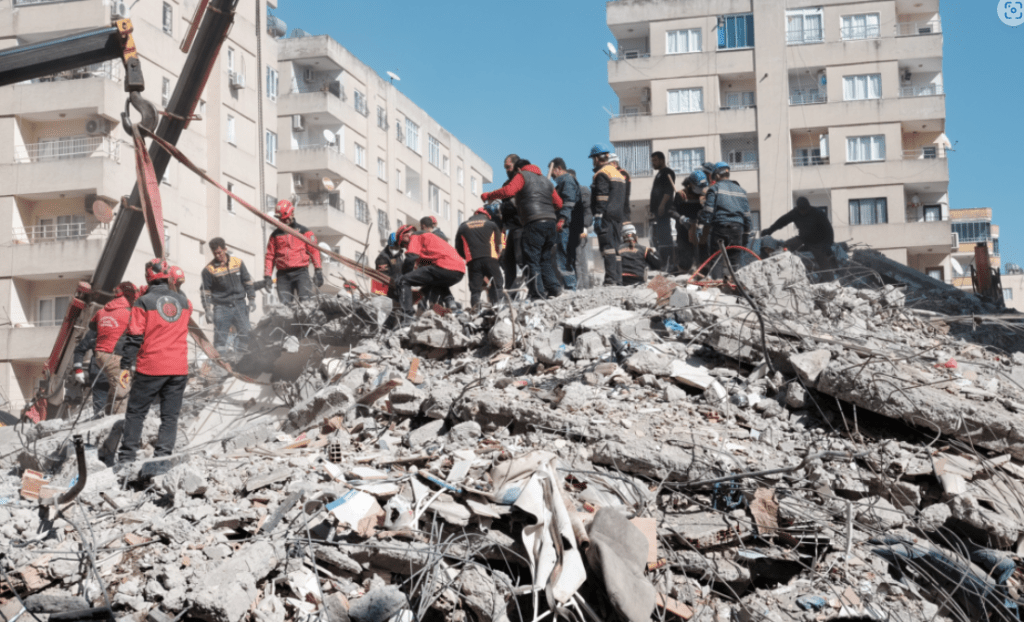
Fig 1: Rescue workers in in Osmaniye, Turkey. Cropped from image by Onur Erdoğan, Public Domain, Wiki Commons
It’s approximately one month on from 6th February 2023 when a 7.8 magnitude earthquake struck on the south western end of the East Anatolian Fault Zone at 01:18 UTC (04:18 local time) 32.4km west northwest of the town of Gaziantep. This, followed by large aftershocks, including a very shallow 7.5 magnitude earthquake to the north of the first quake, caused catastrophic damage in central and southern Turkey, and northern and western Syria. The 7.5 earthquake signalled the rupturing of a second fault zone, the Sürgü-Misis Fault. The final fatality number is not yet available but, at the time of writing, fatalities exceeded 50,000, with hundreds of thousands injured and millions displaced. Our thoughts are with the victims, including those facing a long road to recovery.
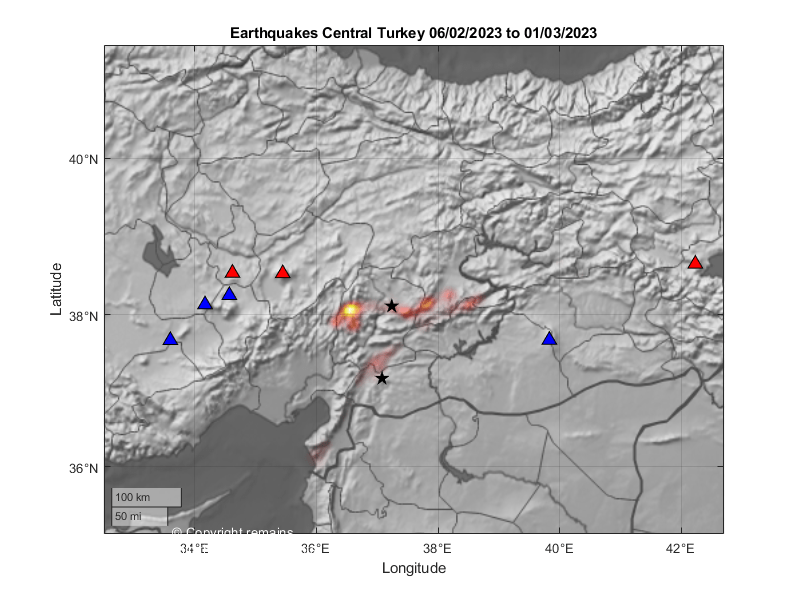
We have taken a look at the earthquakes surrounding the Anatolian Plate from the start of January 2023 to 1st March 2023.
Tectonic Settings
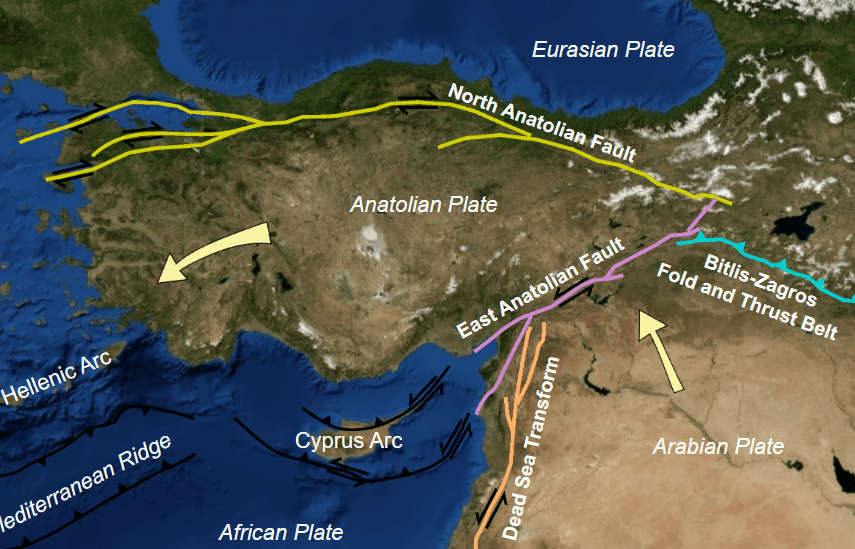
The Anatolian Plate lies between the Eurasian Plate, Arabian Plate and African Plate. The African Plate is moving at a rate of 2.15cm per year in a north easterly direction, the Eurasian Plate is moving south, relative to the African Plate, at a rate of 7-14mm per year, the Arabian Plate is moving northward at a rate of 15-20mm per year and the Anatolian Plate is moving south west at the rate of 21mm per year. The relative motions are accommodated by the North Anatolian Fault, East Anatolian Fault, Bitlis – Zagros Fold and Thrust Belt and Dead Sea Transform Fault System.
Fig 2: Image by Roxy – Own work, CC BY-SA 3.0, Wiki Commons
The East Anatolian Fault is a 500km long fault zone which marks the plate boundary between the Anatolian and Arabian Plates; the boundary is a transform one with left lateral strike slip seismic activity and a slip rate of 10mm per year. The Anatolian Plate is pushed westward by the Arabian Plate moving northwards towards the Eurasian Plate.
The East Anatolian Fault is a single fault between Karliova and Çelikhan. After Çelikhan the fault zone splits into north and south strand, both of which include multiple faults. The Sürgü-Misis Fault makes up the northern strand; it is a 380km long stretching between Çelikhan and Karataş; the eastern parts of the east-west section are made up of the Çardak and Sürgü faults; the sytem changes direction at the Göksun bend dividing into seven north east trending fault systems – the Karataş, Yumurtalık, Toprakkale, Savrun, Misis, Çokak and Düziçi-İskenderun faults. The Sürgü-Misis Fault system connects to the Cyprus Arc via the Misis-Kyrenia fault system. The southern strand of the East Anatolian Fault is less certain; the East Anatolian Fault may extend to the north of Cyprus; and, the NNE trending Türkoğlu-Amik section (the Karasu Fault Zone) may be a separate fault, linking the Dead Sea Transform to the East Anatolian Fault. The Karasu Rift has had Quaternary volcanic activity on northern part and sides of the rift between Kirikhan, Reyhanli and Fevzipaşa in an area 94km long and 12-25km wide.
The North Anatolian Fault, another strike slip fault, accommodates the relative motion between the Anatolian Plate and the Eurasian Plate. The North Anatolian Fault and the East Anatolian Fault meet the Bitlis – Zagros Fold and Thrust Belt, where the Arabian Plate subducts under the Eurasian Plate, at the Karliova Triple Junction.
Not very far to the west, the African Plate is subducting under the Anatolian Plate at the Cyrpus Arc. The Dead Sea Transform Fault System to the south marks the transform boundary between the Arabian and African Plates. The East Anatolian Fault meets the Dead Sea Transform Fault System at the Maras Triple Junction.
Earthquake Plots
We initially plotted the earthquakes from 1 January 2023 to 25 February 2023 for the area 34.47361°N, 25.22222°E to 42.25833°N, 44.45056°E. We then looked at 35.3122°N, 32.50944°E to 41.21667°N, 42.70056°E, focussing on the East Anatolian Fault. The results are shown in the following videos and earthquake density plot.
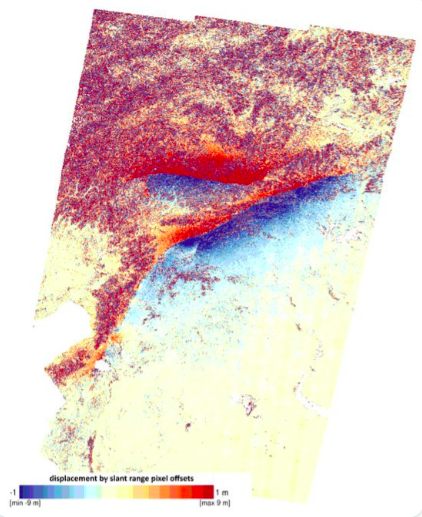
Fig 7: Surface rupture from the two earthquakes as shown by analysing before and after satellite images. The first rupture on the East Anatolian Fault was 190km long and the second on the Sürgü-Misis Fault was 38km long (Image credit: Copernicus/NERC/COMET)
Most of the faults within the East Anatolian Fault Zone seem to have moved in the period we looked at. However, the scale of our plots may be misleading. Our plots do show a tenuous link between the East Anatolian Fault and the Cyprus Arc. There was some activity on the Arc preceding the 7.8 earthquake. After shocks have migrated through the fault system towards the Arc. There is no obvious link with the Dead Sea Transform Fault in the time period selected but geologically-speaking that is a very short period.
“Paleoseismology of the western Sürgü–Misis fault system: East Anatolian Fault, Turkey”, Tamer Y. Duman, Hasan Elmacı, Selim Özalp, Akın Kürçer, Meryem Kara, Ersin Özdemir, Ayhan Yavuzoğlu & Çağıl Uygun Güldoğan, Mediterranean Geoscience Reviews volume 2, pages411–437 (2020) https://link.springer.com/article/10.1007/s42990-020-00041-6
We are no longer updating this post; future updates will be included in new posts.
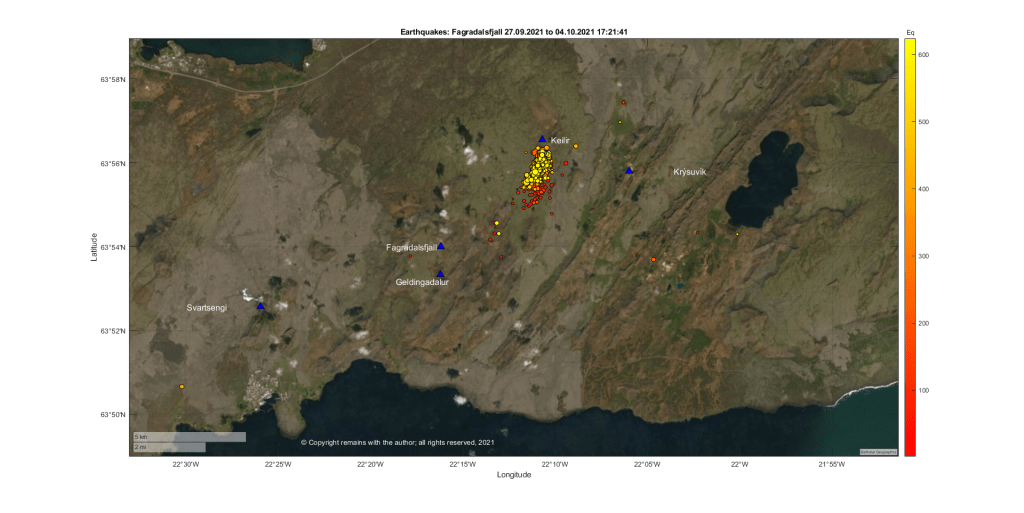
Update 2 12.10.2021: Plots of the Earthquake Swarm SSW of Mount Kelir, 27/09/2021 to Date
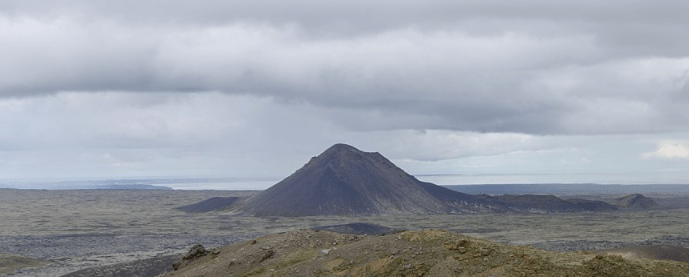
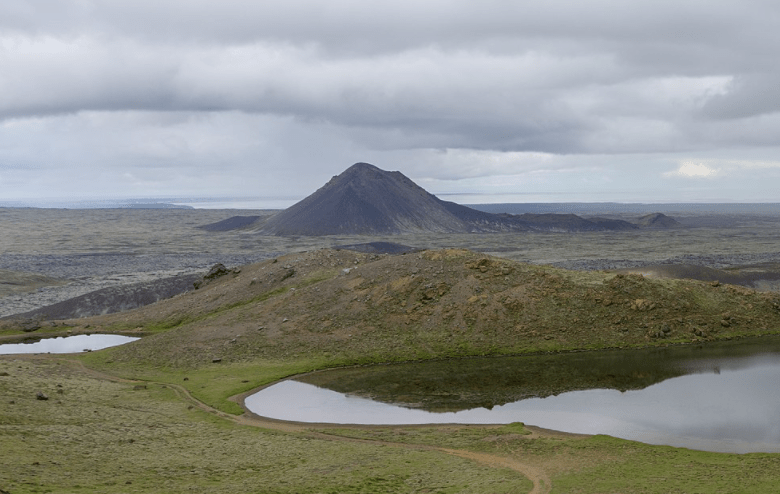
Fig 16: Mount Kelir, cropped from an image by Michal Klajban, published under CC BY-SA 4.0. Source: Wikimedia Commons
Mount Kelir is at the northern end of the earthquake swarm which started on 22 February 2021. In that swarm, earthquakes started near Mount Kelir and migrated towards and beyond Fagradalsfjall prior to the eruption at Geldingadalir on 19 March 2021.
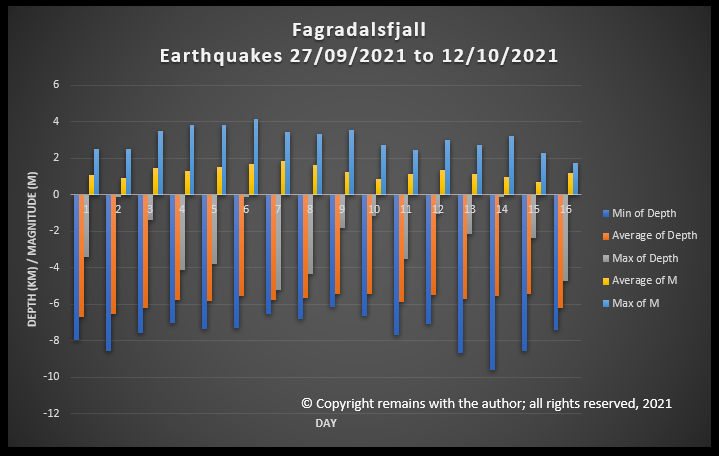
The current swarm which started on 27 September 2021 near Mount Kelir is ongoing at the time of writing. Over 10,000 earthquakes have been recorded, of which IMO have confirmed c. 1,245. It is thought that an eruption may ensue near Mount Kelir.
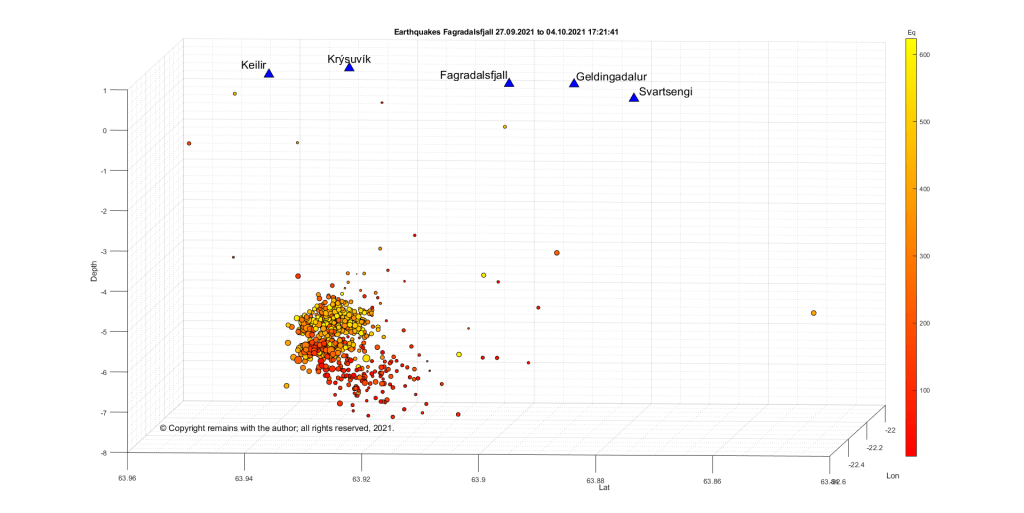
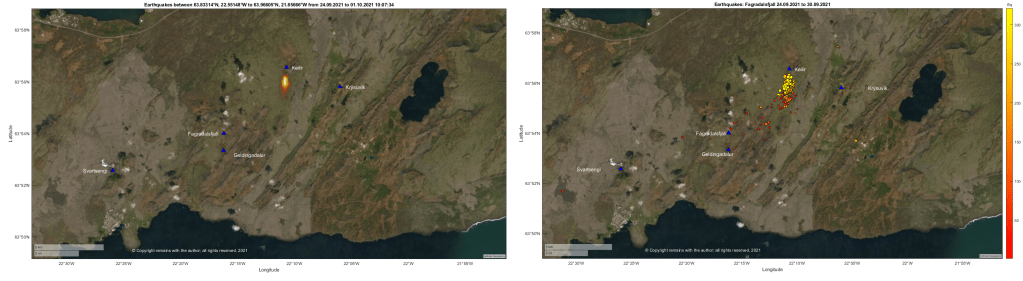
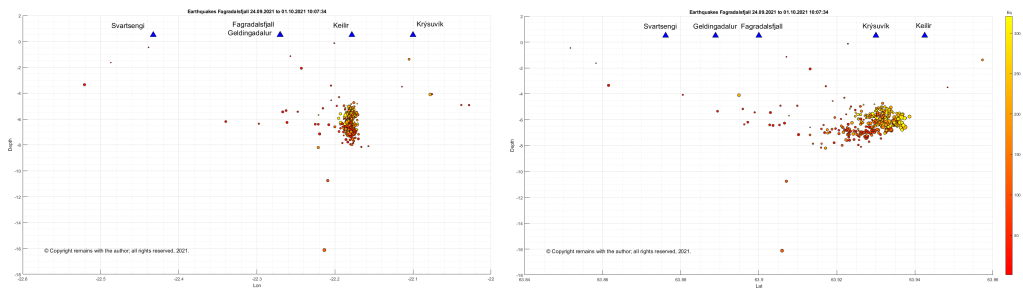
We have plotted the earthquakes and made a video of the geoscatter and scatter plots.
Whether or not a new eruptive site emerges, magma migrates to the existing site at Fagradalsfjall, or, it all quietens down, only time will tell. At the moment the swarm is migrating SSW.
Source for raw earthquake data: Icelandic Met Office: IMO
12.10.2021 1: Update on La Palma Seismicity
Good Morning!
Let’s take look at status of the eruption and seismicity at La Palma.
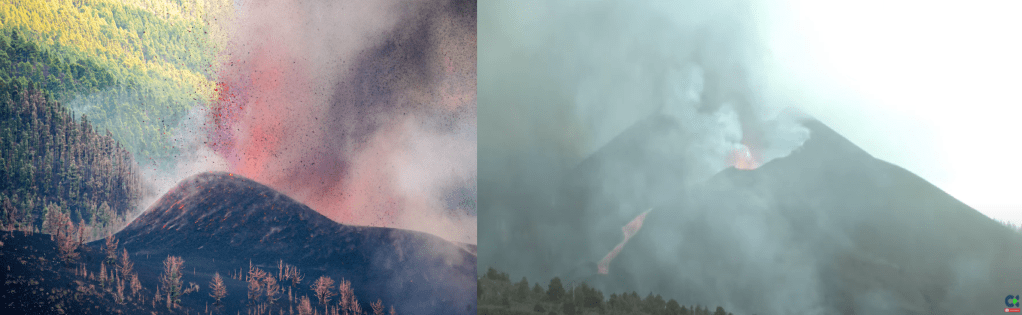
The eruption is still going strong. The cone has grown substantially, despite partial collapses.
Fig 11: Cone growth. On the left, the new cone on 20 September, 2021, cropped from an image by Eduardo Robaina, published under CC BY-SA 3.0; on the right, screen shot earlier today from RTVC
The following was reported earlier today:
The lava reached the cement works, Callejón de la Gata, today. Local residents were confined to their homes due to the risk of toxic fumes from burning chemicals.
A large volume of lava was emitted after the wall of the lava lake [cone?] was destroyed.
The northern arm of the lava flow is now 300 metres from the sea and expected to make a new lava delta near the beach of Perdido.
591.1 hectares have been affected by lava. This includes 132 hectares of crops , of which 70 hectares were banana crops; 33 hectares vineyards; and, 8 hectares avocado crops.
The maximum width of the lava flow is 1,520 metres.
1,281 buildings have been impacted, of which 1,186 have been destroyed.
The lava delta is now 34 hectares.
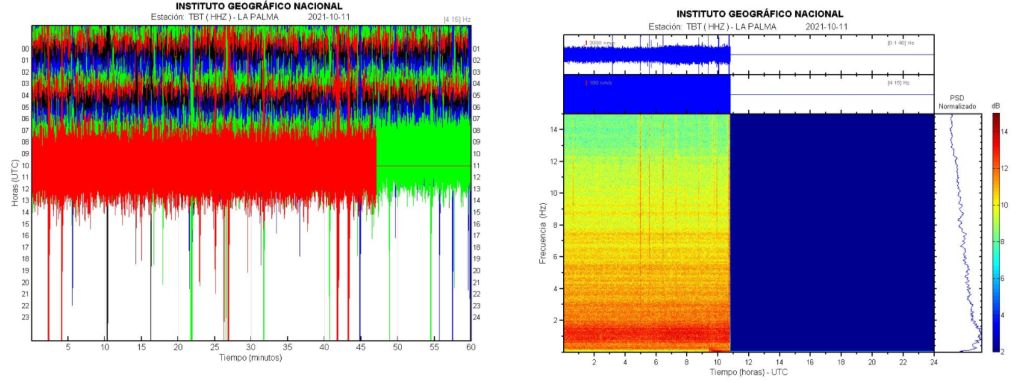
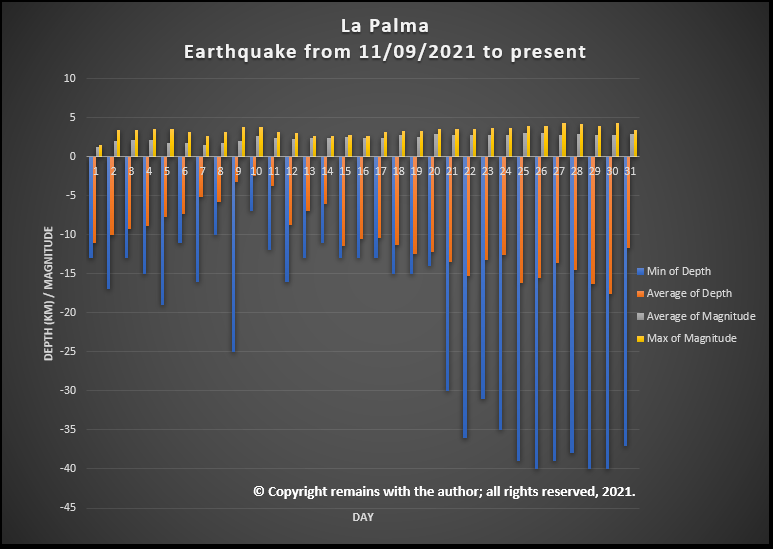
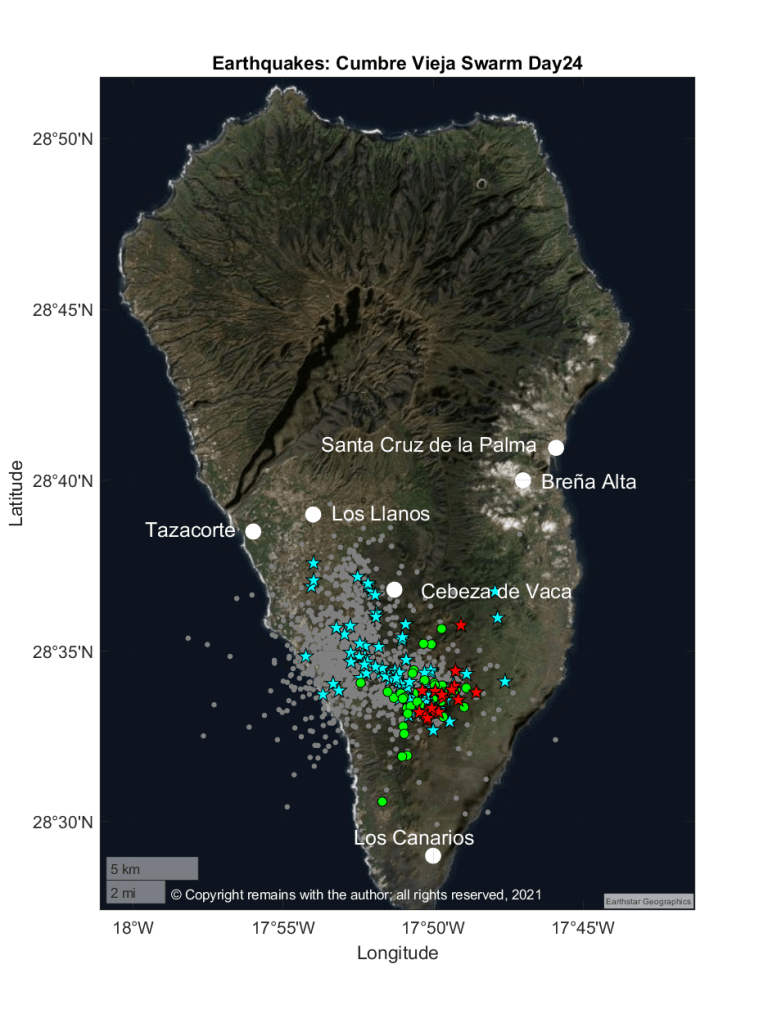
Seismicity remains high. To date, over 35,000 earthquakes have been recorded. The most recent earthquakes remain below 10km, with depths reaching more than 20km.
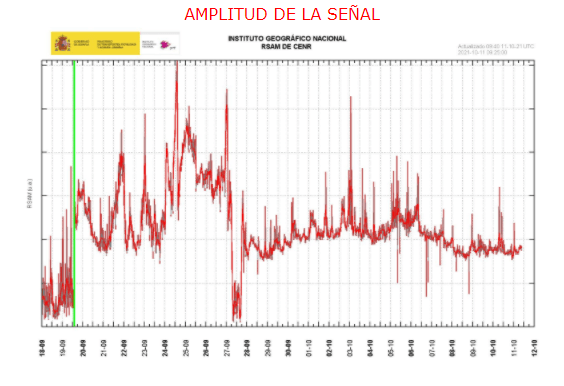
The high level of seismicity is thought to indicate rising magma because there have been spasmodic tremors and a strong volcanic tremor at 18 Hz; the latter may be from depressurisation of magma at a depth of c. 10km. In the absence of increased ground deformation, it is not known when or how magma may reach the surface. If it reaches the surface, it may follow the current conduit or emerge at new fissures.
Fig 12: Amplitude of seismic signal, source: IGN. Green line denotes onset of the eruption.
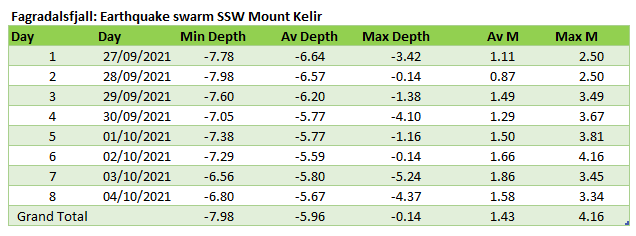
04.10.2021: Update Fagradalsfjall Seismic Swarm near Kelir
The swarm near Mount Kelir is ongoing. IMO report that 6.200 earthquakes have occurred in the swarm, although c.624 have been confirmed at the time of writing (Sources: IMO_Earthquakes and Skjálfta-Lísa (vedur.is)).
We have analysed and plotted the swarm. It would appear that the swarm is ascending but still in the crust. The largest earthquake with a magnitude of 4.16 had a depth of 5.669 km.
Good Morning! Today we provide an update on Fagradalsfjall, Cumbre Vieja (with video of earthquake swarms) and Askja.
Fagradalsfjall, Iceland
Fig 1: Mount Kelir, cropped from an image by Michal Klajban, published under CC BY-SA 4.0. Source: Wikimedia Commons
Fagradalsfjall celebrated the six-month anniversary of the start of the eruption, which occurred on 19 March 2021, by taking a break. Low level activity has been observed since 18 September 2021.
An earthquake swarm stared on 27 September 2021 south of Mount Kelir. This is located near the northern end of the earthquake swarms earlier this year which preceded the eruption at Geldingadalir.
We have plotted the swarm to see what is going on.
While it is not clear what the cause of the swarm is (new magma or the crust adjusting to changes in tension), people are advised to avoid the area for the time being. If an eruption does occur near Kelir, it is expected to be similar to that at Fagradalsfjall. The aviation code is still orange.
Cumbre Vieja, Canary Islands
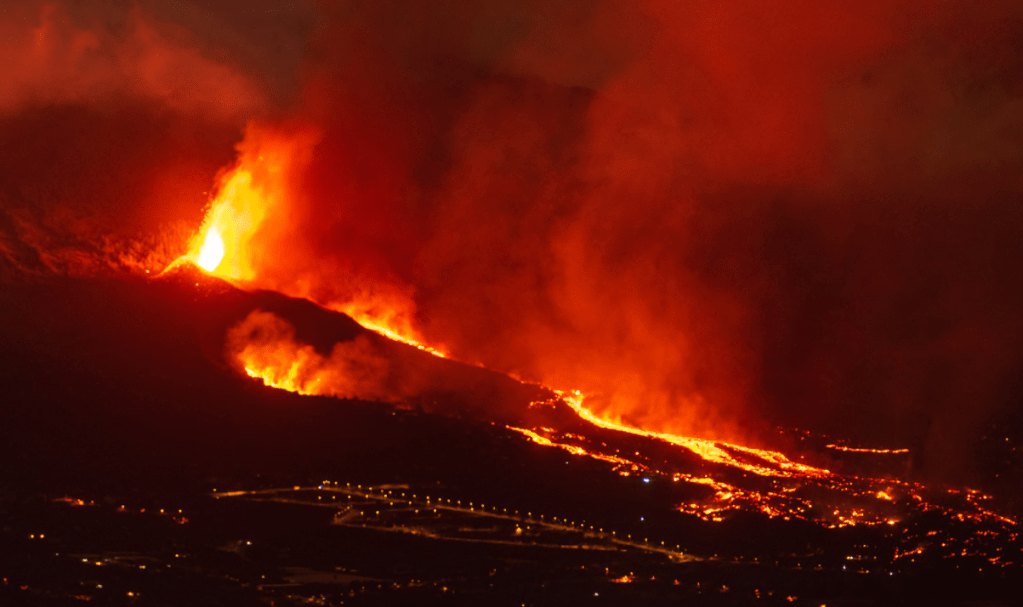
Fig 3: Cumbre Vieja eruption on 20/09/2021, cropped from an image by Eduardo Robaina, published under CC BY-SA 3.0. Source:Wikimedia Commons
The eruption is still going strong. The vents have produced ash columns, jetting lava and effusive lava flows.
Lava reached the sea, following the opening of a new vent earlier this week, which emitted more effusive lava. The lava travelled at 300 m/hr, crossing the coastal road and cascading over 100m high cliffs at Los Guirres. The lava is forming a delta, which has reached an impressive size 21 hectares.
There are now four eruptive vents: a new effusive vent opened 400m north of the main vent on Thursday; and, two more opened on Friday 15 metres apart and 600m north west of the main cone. Lava from Thursday’s new vent also made it to the sea via a flow parallel to the original one. A fumarolic field has developed on the north side of the main vent.
Over 80 million cubic metres of lava have been erupted. Sadly, this has damaged 1,005 buildings, of which 870 have been destroyed. 30.2km of road has been impacted, of which 27.7km have been destroyed. Ash now covers 3,172.9 hectares of land.
SO2 levels are higher but not considered a risk for the population at the moment.
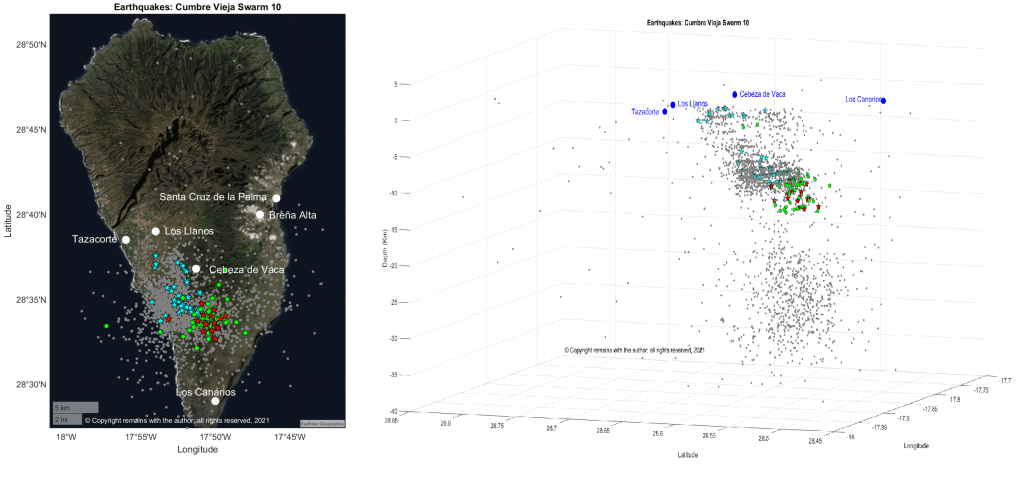
Earthquakes are occurring near the area start of the swarm which preceded the eruption. They are deeper than the earlier swarm leading to concern that lava may be fed from a deeper reservoir. We have plotted the current swarm and previous swarms from 2017 to date.
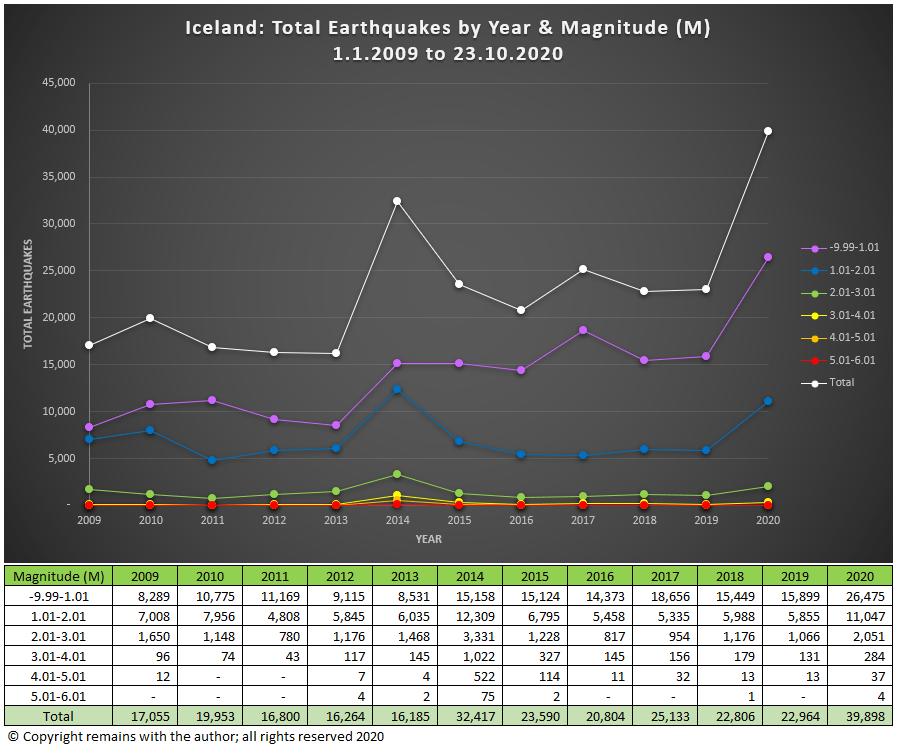
While we are waiting to see if there is any volcanic activity at Grímsvötn or her neighbours, let’s take a look at how the current seismic activity in Iceland compares to previous years.
Our database, comprised of earthquake data downloaded from IMO (see Sources below), now goes back to 29 December 2008 and extends to 23 October 2020, although we may reupload the last week soon because IMO may have been in the process of updating the record when we downloaded the data.
From our graph, we can see that the total number of earthquakes was up in 2010, 2014, 2017 and 2020. In 2010, Eyjafjallajökull erupted, in 2014, Barðarbunga erupted at the Holuhraun fissure; in 2017, there was no subaerial volcanic activity, although Katla may have had some subglacial activity, and, in 2020, there is rifting both in the Reykjanes Peninsula and Tjörnes Fracture Zone but we have yet to see what, if any, volcanic activity emerges. Interestingly, the 2011 eruption of Grímsvötn did not push the total earthquakes up in 2011.
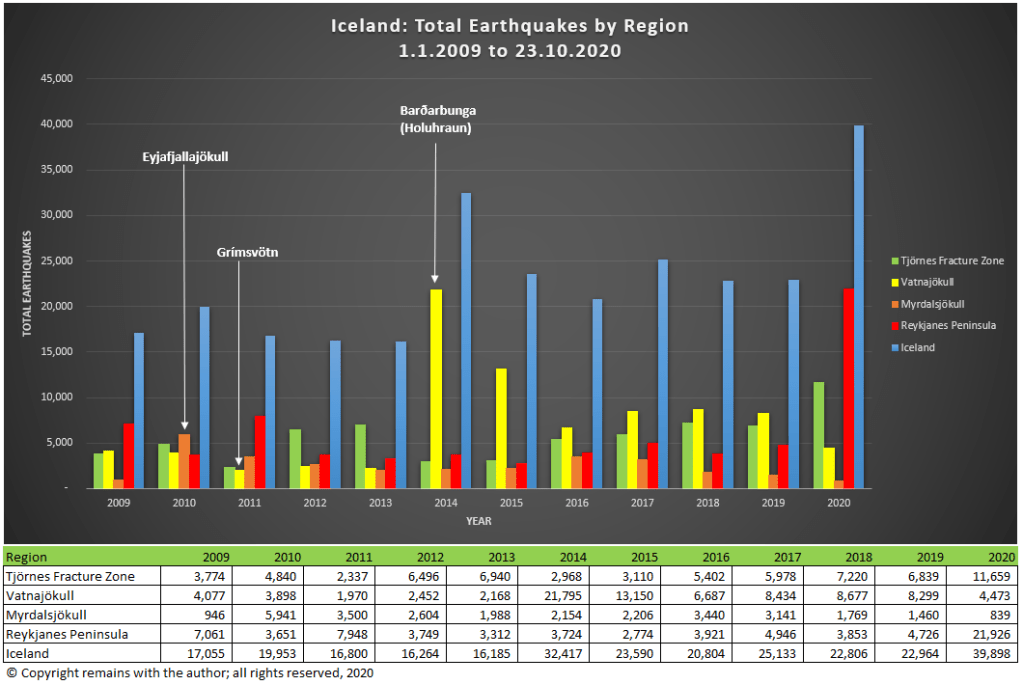
Let’s take a look at activity by region. Here we look at the four main volcanic regions: the Tjörnes Fracture Zone, Vatnajökull, Myrdalsjökull and the Reykjanes Peninsula, where there is most seismic activity.
Fig 2: Iceland Total Earthquakes by Region and Yearby the author, using data downloaded from IMO (see Sources below). Note: not all regions
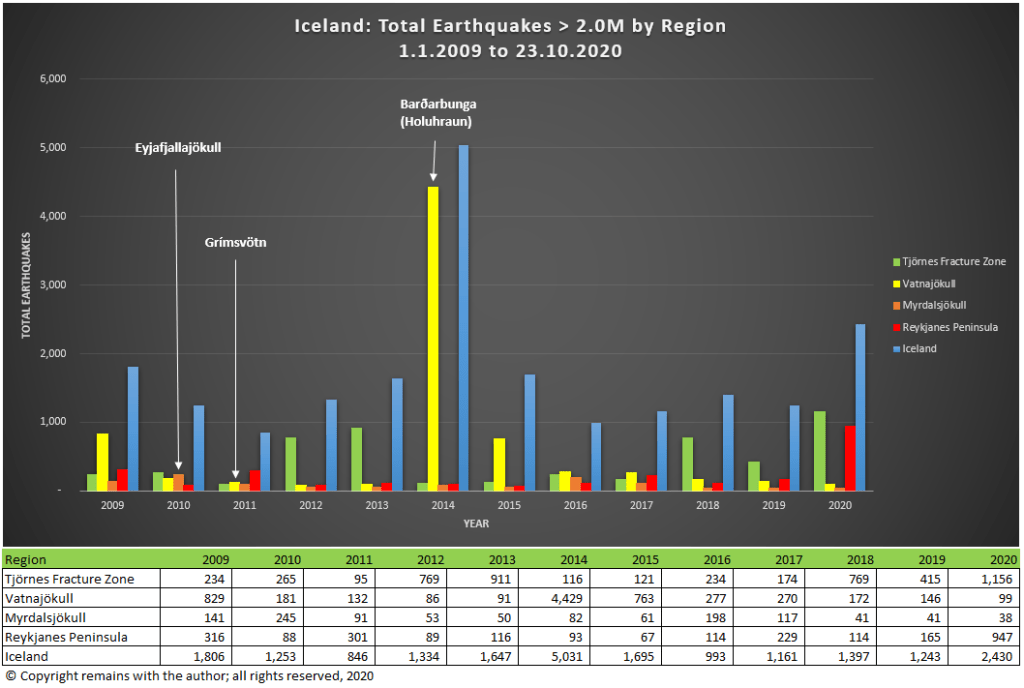
We see that the eruption of Eyjafjalljokull increased the number of earthquakes in Myrdalsjökull but not to the extent that the eruption of Barðarbunga at the Holuhraun fissure and subsidence in the caldera pushed up the earthquakes for Vatnajökull in 2014 and subsequent years. In fact, the total number of earthquakes in all regions, except Myrdalsjökull, has remained elevated since Holuhraun.
Our database does not extend back far enough to draw any firm conclusions, however, it would appear that rifting events such as Holuhraun produce far more earthquakes than volcanic activity on its own.
Tjörnes Fracture Zone and on the Reykjanes Peninsula
This rather begs the question as to what is happening this year with the large earthquake swarms both in the Tjörnes Fracture Zone and on the Reykjanes Peninsula. Unless our database does not go back far enough, neither the 2011 Grímsvötn nor the 2014 Barðarbunga eruption was preceded by such large earthquake swarms in other regions.
The fact that there is significantly raised activity this year in both regions suggests to us that we may be witnessing the normal plate separation on the Mid Atlantic Ridge (it is not entirely smooth), possible local magma ascent, and / or the plates accommodating an ascending blob of magma from the mantle plume, which is believed to be under the Vatnajökull icecap. There is ground deformation at several spots under the Vatnajökull icecap which points to magma ascent.
IMO have reported that there could be a magmatic intrusion at depth on the Reykjanes Peninsula; this is supported by ground deformation.
Gas measurements, ground deformation and recent seismic activity at Grímsvötn (not enough to show in our graphs but above the background levels for the volcanic system) have led to the Icelandic authorities to consider that an eruption is possible there in the not too distant future and to raise the alert level a notch (see earlier article).
It is too soon to tell whether or not the rifting events, themselves, will result in eruption(s); it is possible that it is just a coincidence that we are seeing two large rifting events at roughly the same time – both areas are seismically active. Time will tell.
All good books on volcanoes describe well-known eruptions, including Vesuvius 79 AD, Tambora 1815, Krakatau 1883, Mount Peleé 1902, Katla 1918, Mount St. Helens 1980, Pinatubo 1991. Who are we to be any different?
There is a good reason for this. Most famous eruptions are large and explosive, causing loss of life and considerable property damage – in other words, headline-grabbing. Later eruptions have impacted aviation – volcanic ash and jet engines are not a good mix; airports near erupting volcanoes are closed and flights re-routed to avoid the ash clouds.
Catastrophic events are the reason volcanology is such an important subject. Understanding these and other eruptions is important to find out how to minimise the risk; i.e. reduce loss of life.
Researchers have shown that volcanoes usually very kindly give us some warning in the lead up to an eruption. Magma is viscous, rarely moves fast and, when moving, causes earthquakes, usually small, but some are felt without equipment. As magma ascends, degassing starts to occur, some of which is detectable at the surface. Rising magma also causes ground deformation, e.g. it causes the volcano to inflate, measurable by tilt-meters and GPS, and some of which may even be visible to the naked eye (Mount St Helens).
I read somewhere that the first piece of equipment required to monitor a volcano is a seismometer, the second is another seismometer, as is the third; earthquakes are often the first sign of impending trouble (if I can remember / find the source, I will accredit it properly). Scientists observing volcanoes will have a raft of equipment in place: seismometers, GPS stations, tilt-meters and gas monitoring; satellite monitoring may also detect ground deformation. Drones may be used to inspect craters which are not readily accessible or where it would be unsafe to visit. Our maps of Iceland include some GPS stations as markers to indicate where the earthquakes are occurring but still evidence that Iceland has several in place at its active volcanoes.
Given that volcanoes give some warning, why are people killed? Unfortunately, magma ascent and the build up to an eruption is a slow process with many stops and starts. A major eruption may be preceded by a few small throat clearing events before the volcano unleashes the main eruption. An evacuation may take place, but if it is quiet between the precursors and the main event, people may think that the volcano has finished and return home to be at ground zero at the wrong time, irrespective of whether or not any alert is in place. People living close to volcanoes tend to be farmers with strong bonds to both their land and livestock. On the other hand, the volcano may not behave as expected – e.g. a phreatic eruption or edifice failure. Volcano hazard assessment is an interesting topic for future posts.
We will also look at some of the more famous eruptions over the coming weeks.
The earthquake swarm which started in December 2019 is continuing, let’s have a quick update on the stats.
Statistics
There have been 19,675 earthquakes in the Reykjanes Peninsula area 64.4°N, 23.0°W to 63.7°N, 21.0°W for the period 1 Jan 2016 to 14 June 2020, of which 14,258 (72%) have occurred in the last six months, most associated with the swarm near Svartsengi.
The geodensity plots for months 48 (December 2019) onwards (Figs 3.1 and 3.2) show that the most intense action started to the east of Mt Thorbjörn and has migrated west to Svartsengi and beyond.
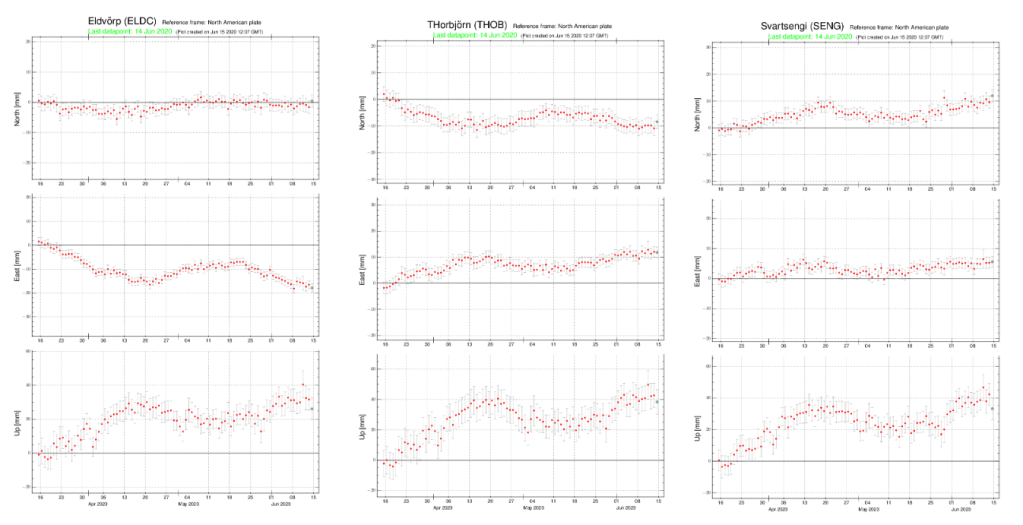
IMO has confirmed that uplift has resumed in the vicinity of Mount Þorbjörn. Ground deformation is clearly visible on the GPS plots.
Fig 4:Uplift in the vicinity of Mt Þorbjörn as shown in recent GPS plots published by IMO: GPS Þorbjörn. THOB moved south eastwards, SENG moved north eastwards and ELDC moved westward; all showed uplift.
Summary
We are still looking at an unusually large swarm, accompanied by continued uplift in the vicinity of Mt Þorbjörn.
At the time of writing, there has been no change in the uncertainty phase declared by Icelandic Civil Protection .
The Armchair Volcanologist
15 June 2020
Sources:
Raw earthquake data and GPS plots downloaded from the Icelandic Met Office: https://en.vedur.is


 An Armchair Volcanologist


