Tag Archives: Fagradalsfjall

Updated Earthquake Plots for Svartsengi and Krýsuvík, 24th October 2023 to 9th March 2024

While waiting to see where and when the next eruption on the Reykjanes Peninsula occurs, we have updated our earthquake plots for the area between 63.746°N, 22.631°W and 63.996°N, 21.864°W from 24th October 2023 to 9th March 2024 – a total of 12,988 earthquakes.  We have extended the area plotted to include Krýsuvík.

First, we start with the geodensity plot for the period 24th October 2023 to 9th March 2024.  Most activity is still occurring on the magma intrusion / graben between Hagafell and Stóra-Skógafell.  The earthquake density plots for the entire period also picks up some activity southwest of Grindavík, west of Fagradalsfjall and at Mount Þorbjörn.  This shows best on a topographic map with a lighter background.

Fig 1: Earthquake density plot by the author of earthquakes occurring between 63.746°N, 22.631°W and 63.996°N, 21.864°W from 24th October 2023 to 9th March 2024. © copyright remains with the author; all rights reserved, 2024.

Next, we look at the geoscatter plot for the same area and period.  This shows the activity along the magma intrusion / graben, that west of Fagradalsfjall, and, also, an upkick in activity in the Krýsuvík area.  The last may be local faults accommodating the uplift at Svartsengi.  Whether or not this lets magma ascend in the Krýsuvík volcanic system, itself, remains to be seen.  At the time of writing, the alert level for Krýsuvík is unchanged at green. 

Fig 2: Geoscatter plot by the author of earthquakes occurring between 63.746°N, 22.631°W and 63.996°N, 21.864°W from 24th October 2023 to 9th March 2024. © copyright remains with the author; all rights reserved, 2024

We have complied a video of the earthquake sequence in increments of 50 quakes.

Fig 3: Video of geoscatter plots by the author of earthquakes occurring between 63.746°N, 22.631°W and 63.996°N, 21.864°W from 24th October 2023 to 9th March 2024. © copyright remains with the author; all rights reserved, 2024.

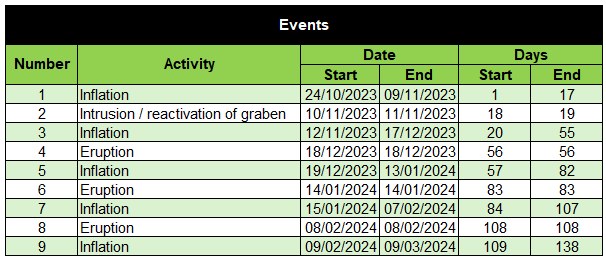
We have also looked at the sequence by the various events (inflation, intrusion / graben formation and eruption).  The events are:

Fig 4: Table by the author of events in the earthquake sequence (inflation, intrusion / reactivation of the graben and eruption).  © copyright remains with the author; all rights reserved, 2024.

For each event we have done the geodensity and geoscatter plots.  These can be found in the video below.

Fig 5: Video of geodensity and geoscatter plots for events by the author of earthquakes occurring between 63.746°N, 22.631°W and 63.996°N, 21.864°W from 24th October 2023 to 9th March 2024. © copyright remains with the author; all rights reserved, 2024.

Other plots

Fig: 6 Combined geoscatter and scatter plots by the author of earthquakes occurring between 63.746°N, 22.631°W and 63.996°N, 21.864°W from 24th October 2023 to 9th March 2024. © copyright remains with the author; all rights reserved, 2024
Fig 7: Scatter plots by the author of earthquakes occurring between 63.746°N, 22.631°W and 63.996°N, 21.864°W from 24th October 2023 to 9th March 2024. © copyright remains with the author; all rights reserved, 2024.

We hope you find the above plots useful.

Armchair Volcanologist

© Copyright remains with the author; all rights reserved, 2024.

Source:

Our thanks go to IMO for the raw earthquake data.  IMO:  Icelandic Meteorological Office

Intense Earthquake Swarm Near Grindavík. Aviation Code for the Reykjanes – Svartsengi Volcanic System Orange_Updated 17/11/2023, 17:30

Good evening

Update 17/11/2023 17:30

The earthquake swarm is continuing as we write, although he magnitude of earthquakes has reduced. As the uncertainty continues, our thoughts are with those required to evacuate Grindavík, those supporting them, the Department of Civil Defence, and the scientists and others monitoring the activity.

According to IMO, ground deformation is continuing at a slower rate.  It is thought that if an eruption occurs, it is most likely to be in the region of Hagafell.  Yesterday, sulphur dioxide was detected in a borehole at Svartsengi located north of Mt Þorbjörn.  The borehole extends eastwards towards the Sundhnúkur crater row, close to the where the magma intrusion is.  This is considered evidence of magma north of Hagafell.  The possibility of an eruption is still considered high.

If we ccompare the locations to our geodensity plots (ref. Fig 31 below), the areas of most seismic activity are located at the Sundhnúkur crater row, Hagafell and northwest Grindavík.  The geodensity plots are often good predictors of where an eruption will occur. However, with three current seismic hot spots, the situation is not clear at the moment.  If an eruption occurs, the precise location(s) will depend on where weak spots allow magma through.

Our updated earthquake plots are below.  The data source is as below.

Seismic activity is occurring along the dike and also at Krýsuvík.

Reykjanes Peninsula

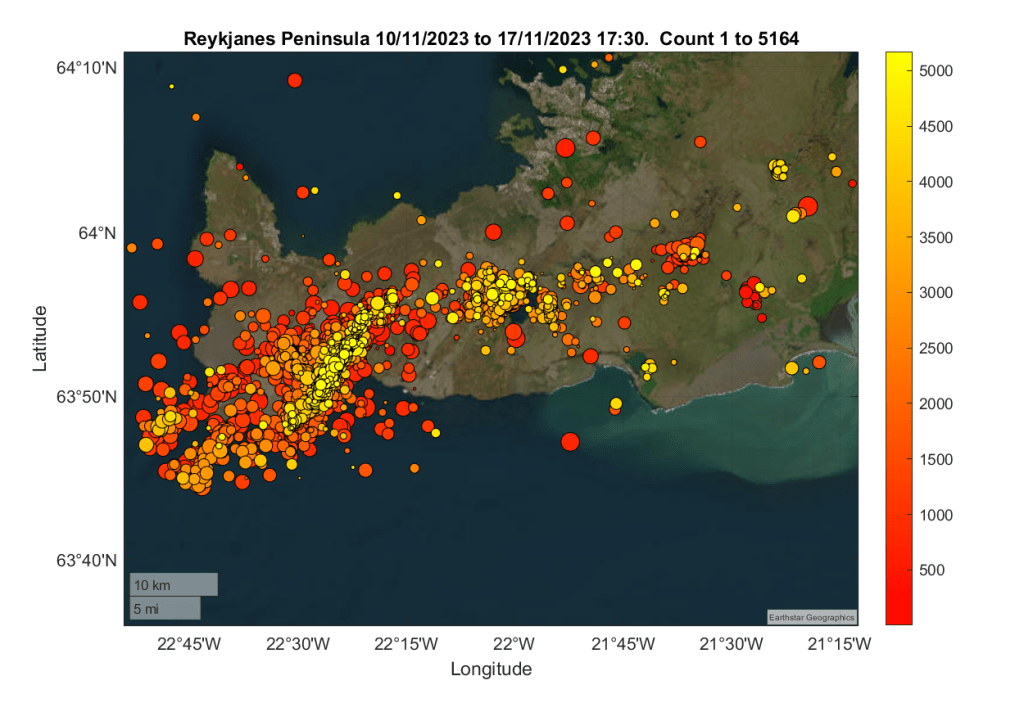
Fig 28: Earthquake geoscatter plot of earthquakes on the Reykjanes Peninsula between 10th November 2023 to 17th November 17:30.  Red denotes earliest earthquakes; yellow denotes latest earthquakes.  © Copyright remains with the author; all rights reserved, 2023.
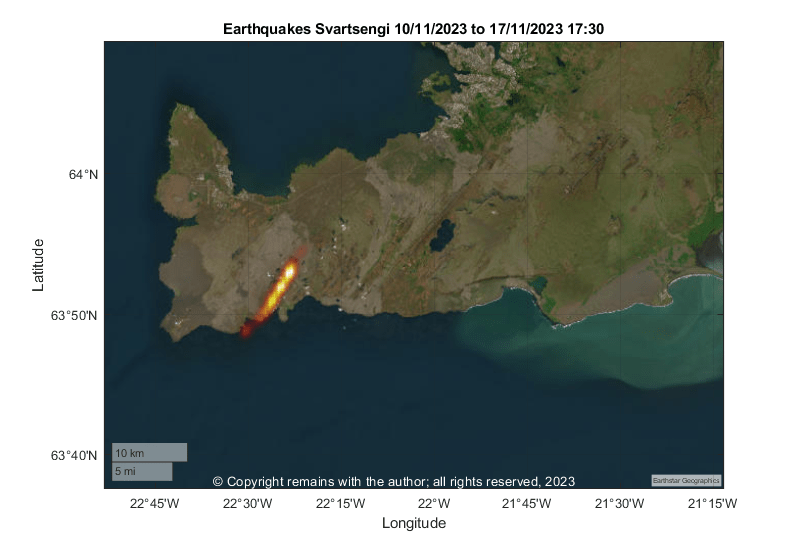
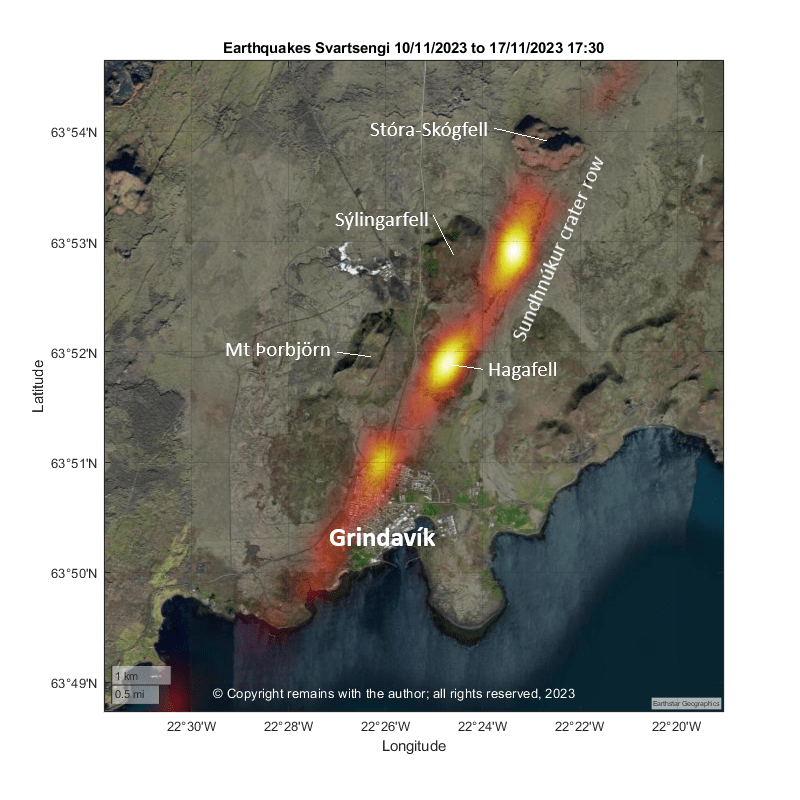
Fig 29: Earthquake geodensity plot of earthquakes on the Reykjanes Peninsula between 10th November 2023 to 17th November 17:30. Most activity is occurring along the dike. © Copyright remains with the author; all rights reserved, 2023.

Area 63.746°N, 22.631°W to 63.996°N, 22.211°W

These show the activity near the dike in more detail.

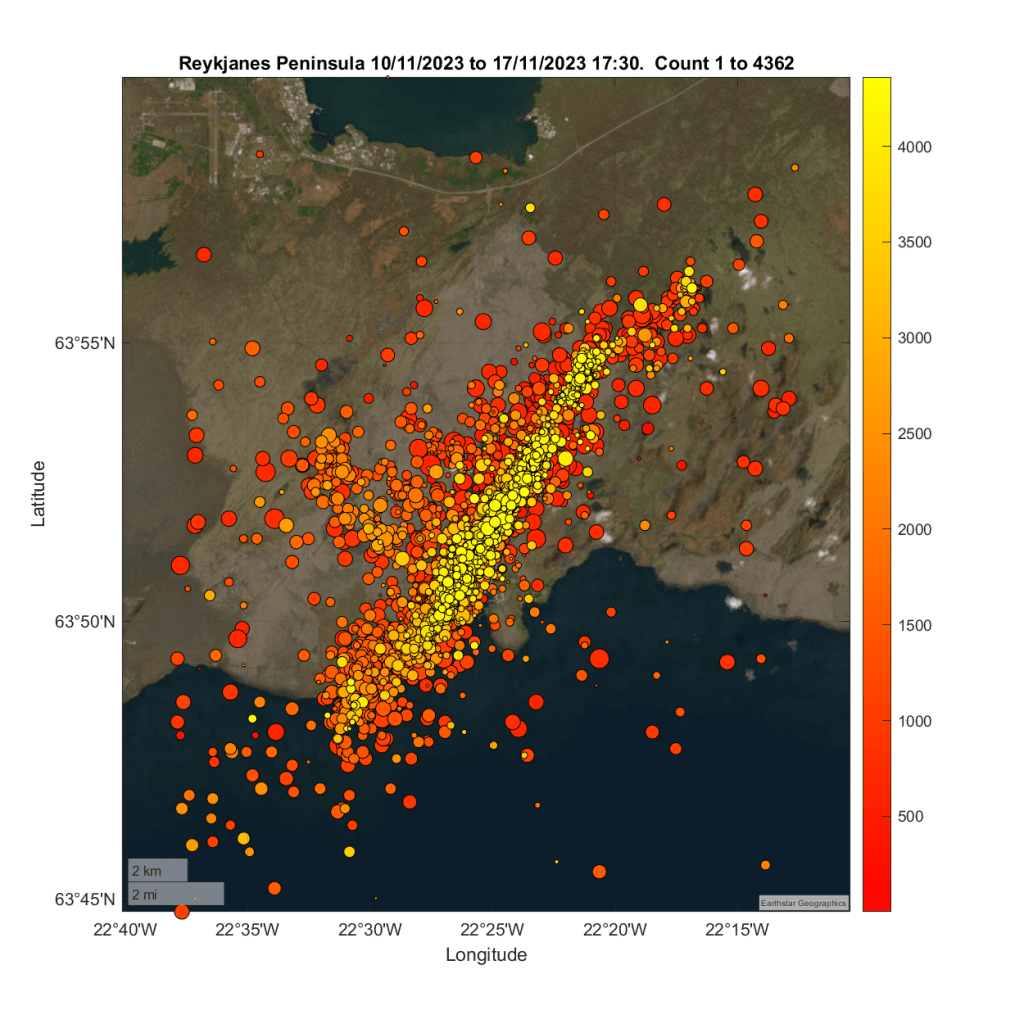
Fig 30: Earthquake geoscatter plot of earthquakes for area 63.746°N, 22.631°W to 63.996°N, 22.211°W between 10th November 2023 to 17th November 17:30.  Red denotes earliest earthquakes; yellow denotes latest earthquakes.  © Copyright remains with the author; all rights reserved, 2023.
Fig 31: Earthquake geodensity plot of earthquakes for area 63.746°N, 22.631°W to 63.996°N, 22.211°W between 10th November 2023 to 17th November 17:30. There are three seismic hot spots: northwest Grindavík, Hagafell and the Sundhnúkur crater row. © Copyright remains with the author; all rights reserved, 2023.
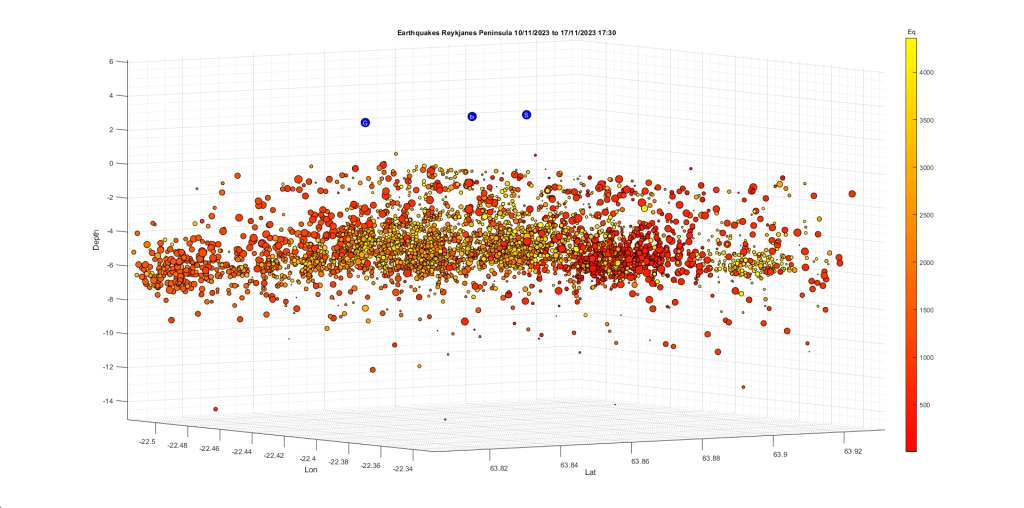
Fig 32: Earthquake scatter plot of the earthquakes for area 63.746°N, 22.631°W to 63.996°N, 22.211°W between 10th November 2023 to 17th November 17:30.  Red denotes earliest earthquakes; yellow denotes latest earthquakes.  G denotes Grindavík, Þ, Þorbjörn and S, the power plant. © Copyright remains with the author; all rights reserved, 2023.

For more recent updates, please consult the relevant authorities, such as IMO.

Armchair Volcanologist

© Copyright remains with the author; all rights reserved, 2023

Sources as below.

Update 15/11/2023 18:50

The earthquake swarm continues as we write.  The intensity has lessened, and the size of the earthquakes decreased.  The probability of an eruption is still considered high.

According to IMO, most monitoring is focussing on the dike formation and Grindavík.  Ground deformation is consistent with magma flowing into the dike.  Part of the magma may be solidifying at the edges of the dike.  Magma inflow is thought to be near Sundhnúk.  SO2 measurements show fluctuating degassing associated with the dike.  Magma may have come within 500m of the surface.  The sink hole which opened in Grindavík continues to widen.

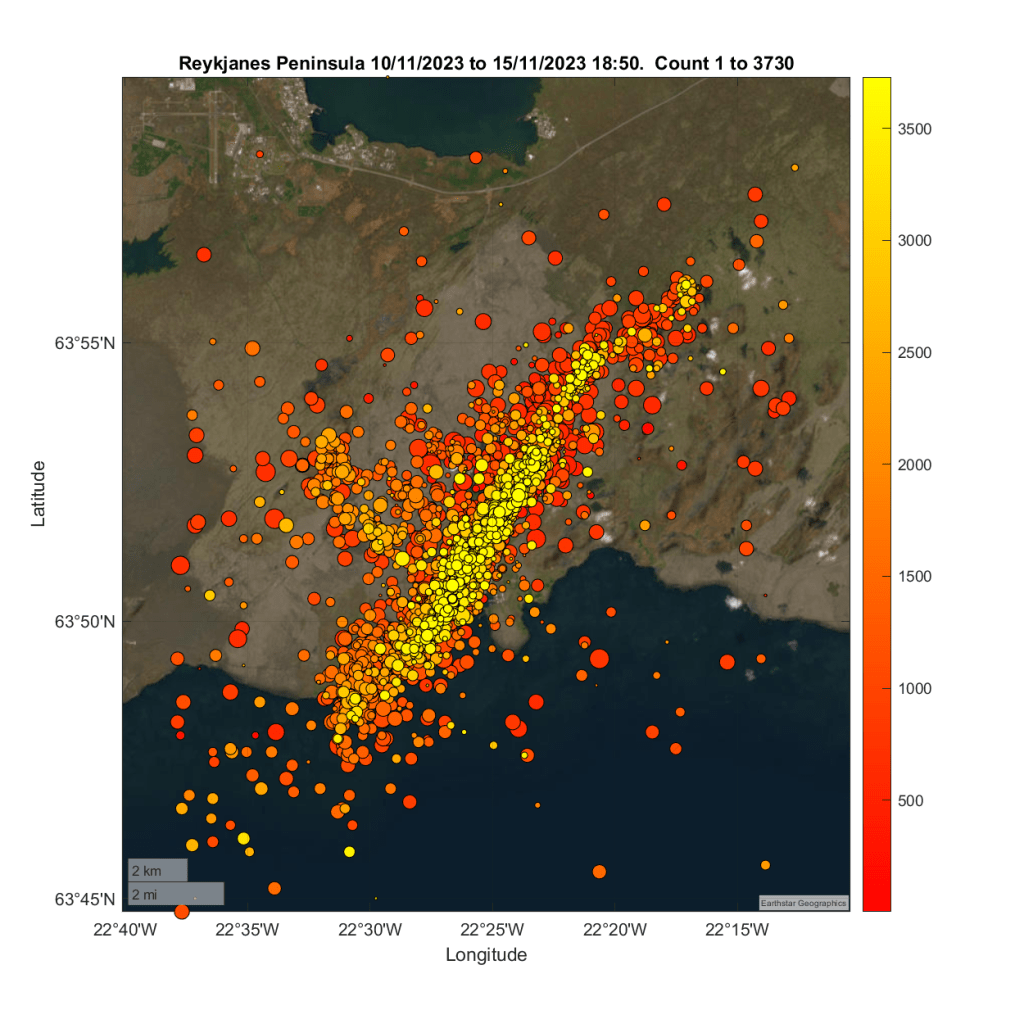
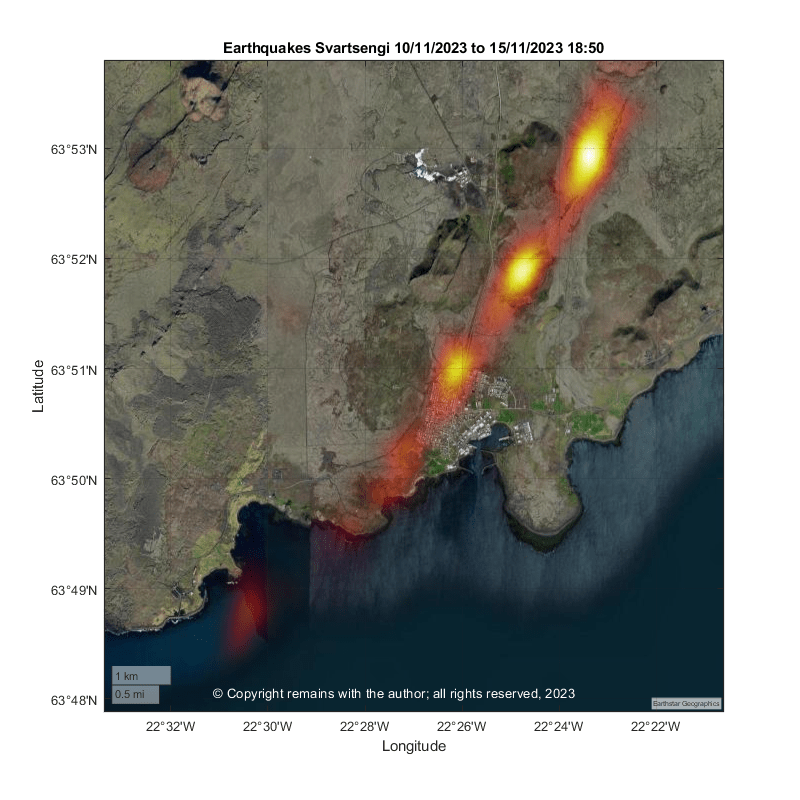
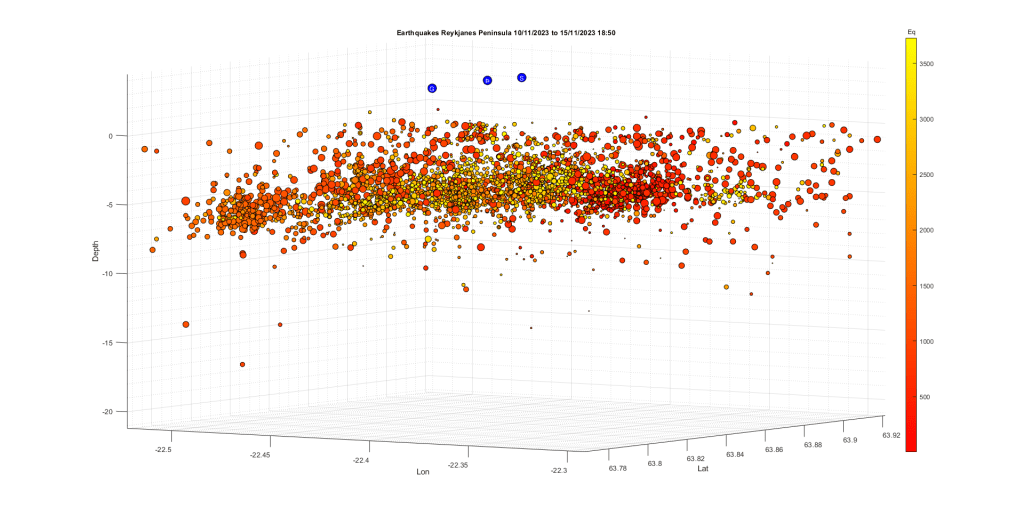
We have updated our earthquake plots to 18:50 today.

The most recent earthquakes occur along the dike, and at Krýsuvík.  We do not understand the relationship between Fagradalsfjall and activity further west, other we have observed than activity at Krýsuvík usually precedes activity west of it.  Frustrating not to be a geologist!

Plots for the Reykjanes Peninsula

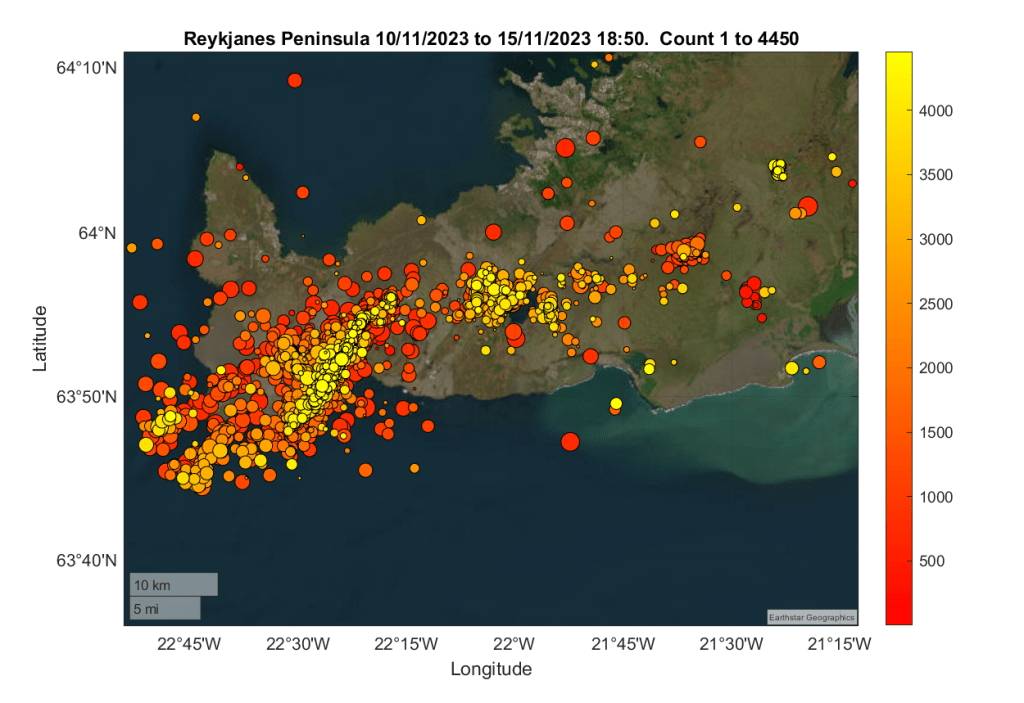
Fig 23: Earthquake geoscatter plot by the author of earthquakes recorded between 10th November 2023 and 15th November 2023 18:50 on the Reykjanes Peninsula (source: Home-page – Icelandic Meteorological Office | Icelandic Meteorological office (vedur.is) using earthquakes with a quality over 90%).  © Copyright remains with the author; all rights reserved.
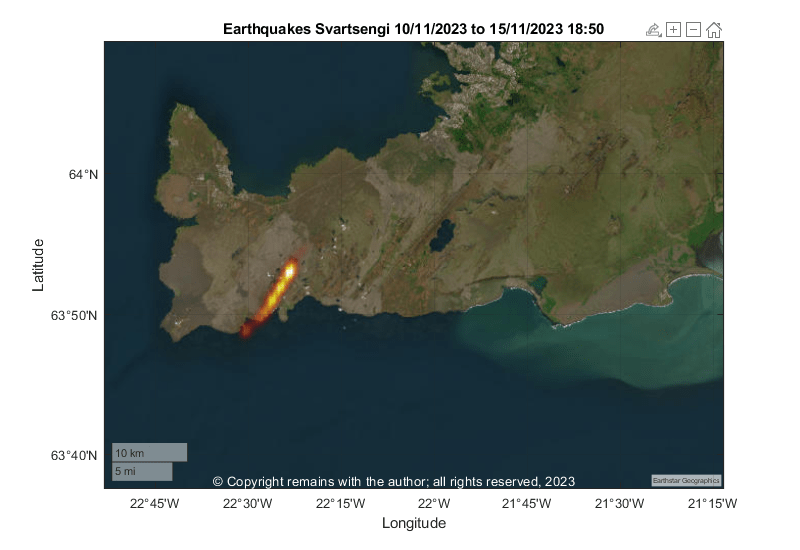
Fig 24:  Earthquake geodensity plot by the author of earthquakes between 10th November 2023 and 15th November 2023 18:50 recorded on the Reykjanes Peninsula (source: Home-page – Icelandic Meteorological Office | Icelandic Meteorological office (vedur.is) using earthquakes with a quality over 90%). © Copyright remains with the author; all rights reserved.

Plots for the area 63.746°N, 22.631°W to 63.996°N, -22.211°W

These show the activity near the dike in more detail.

Fig 25: Earthquake geoscatter plot by the author of earthquakes recorded between 10th November 2023 and 15th November 2023 18:50 on the Reykjanes Peninsula (source: Home-page – Icelandic Meteorological Office | Icelandic Meteorological office (vedur.is) for the area 63.746°N, 22.631°W to 63.996°N, -22.211°W using earthquakes with a quality over 90%).   © Copyright remains with the author; all rights reserved.
Fig 26: Earthquake geodensity plot by the author of earthquakes recorded between 10th November 2023 and 15th November 2023 18:50 on the Reykjanes Peninsula (source: Home-page – Icelandic Meteorological Office | Icelandic Meteorological office (vedur.is) for the area 63.746°N, 22.631°W to 63.996°N, -22.211°W using earthquakes with a quality over 90%).   © Copyright remains with the author; all rights reserved.
Fig 27: Earthquake scatter plot by the author of earthquakes recorded between 10th November 2023 and 15th November 2023 18:50 on the Reykjanes Peninsula (source: Home-page – Icelandic Meteorological Office | Icelandic Meteorological office (vedur.is) for the area 63.746°N, 22.631°W to 63.996°N, -22.211°W using earthquakes with a quality over 90%).  G denotes Grindavík, Þ denotes Mt Þorbjörn and S denotes the power plant. © Copyright remains with the author; all rights reserved.

For more recent updates, please consult the Icelandic authorities, such as IMO (link below).

Armchair Volcanologist.

© Copyright remains with the author; all rights reserved.

Sources: information and raw earthquake data, Home-page – Icelandic Meteorological Office | Icelandic Meteorological office (vedur.is)

Update 13th November 2023, 14:49

Correction: Fig 20 is for the period 10th November to 13th November (Error was in the image title, not the caption. The plot, itself, is unchanged). Apologies for any inconvenience.

The earthquake swarm continues as we write.  The intensity has lessened, and the size of the earthquakes decreased, most probably reflecting the fact that magma has reached less brittle rock layers nearer the surface.  Scientists have said the magma inflow has lessened, seismic activity is between depths of 2km and 5km but there is no change in the assessment of the likelihood of an eruption.

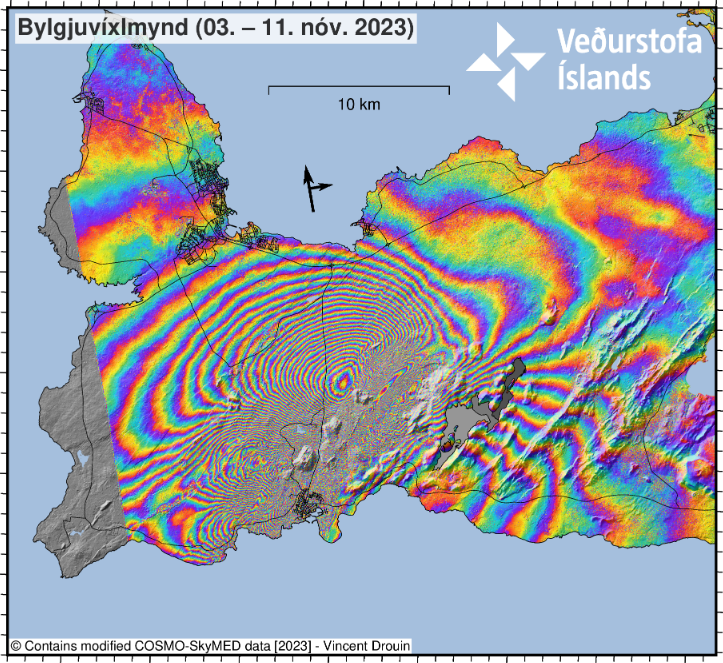
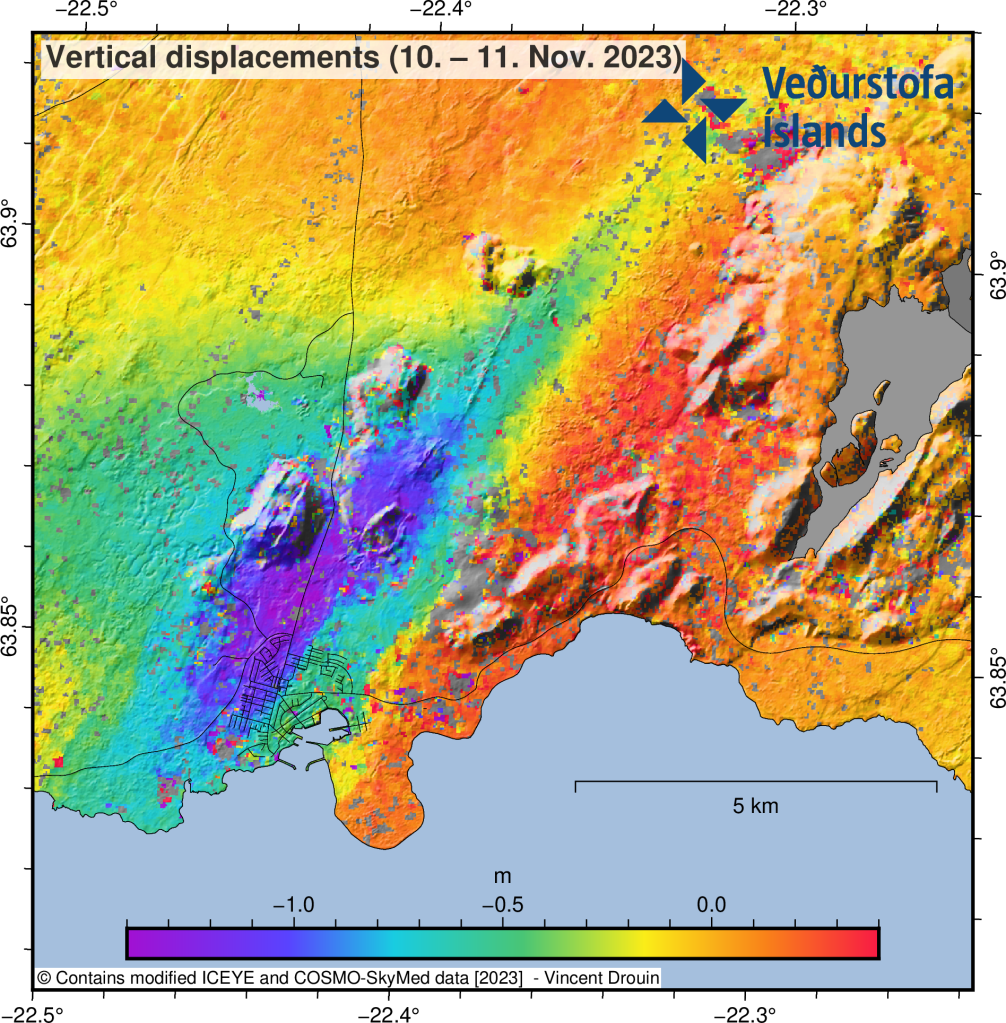
The InSAR image showing the formation of the possible graben running through part of Grindavík has been published on IMO’s site today.  The sudden formation of the graben on Friday night led to the evacuation of Grindavík.  Local news sources have images of the damage done to roads and property.

Fig 15:  InSAR image showing ground displacement caused by seismic activity between 3rd November 2023 and 11th November 2023.  Source: IMO
Fig 16:  Estimate of the vertical displacements caused by the dike during its initial propagation from Friday afternoon to Saturday morning. The displacements were estimated by combining ICEYE and COSMO-SkyMed pixel offset tracking results.  Source: IMO.

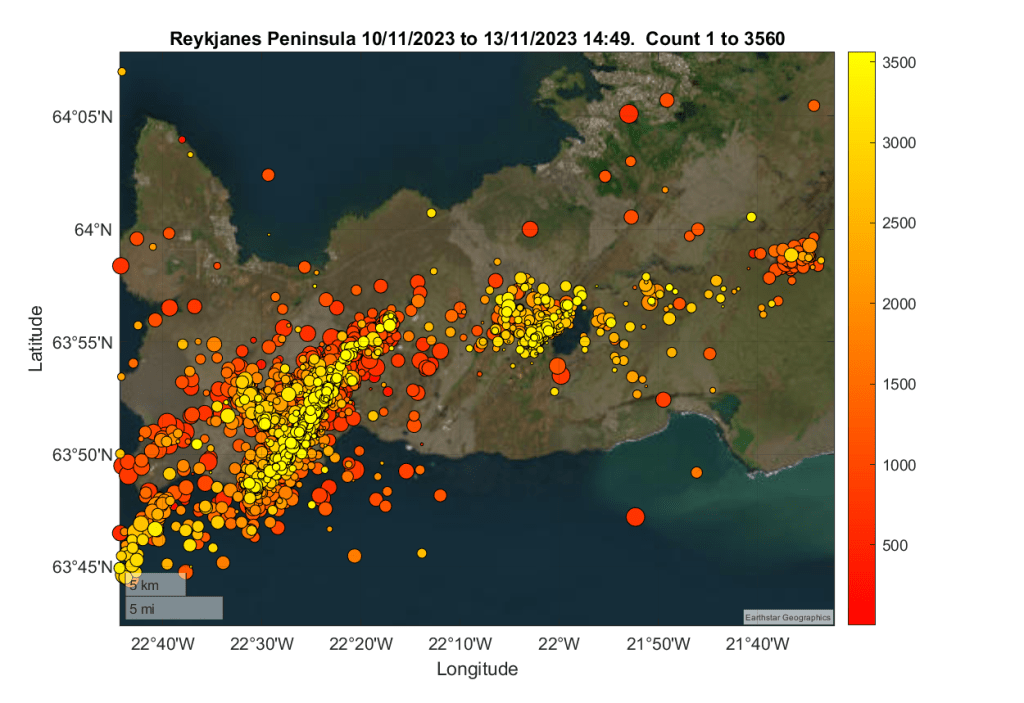
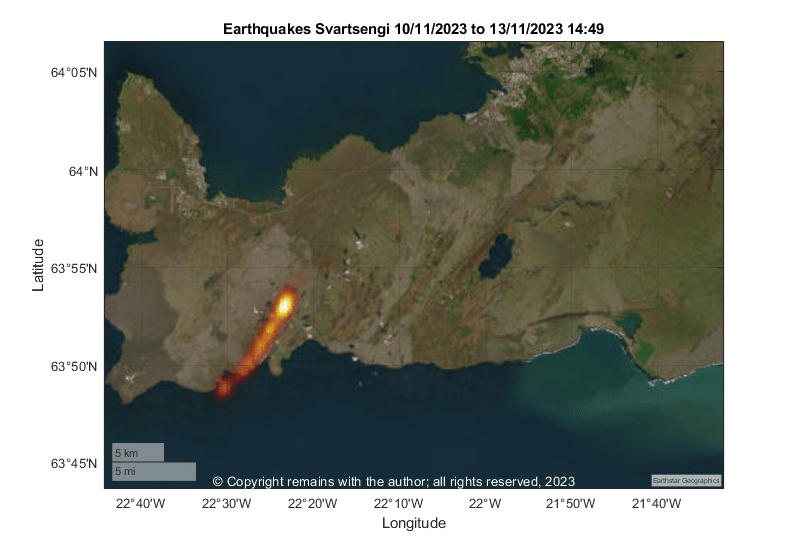
We have updated our earthquake plots for the swarm from 10th November 2023 to 13th November 2023 14:49.  We used the earthquakes published on  Whole Country (vedur.is)  for the Reykjanes Peninsula with a quality of over 90%., a total of 3,560 earthquakes. We may have picked up some ghosts and other errors (confirmed earthquakes have a quality of 99%) but we believe that this will give a rough idea of what is going on.

Fig 17:  Earthquake geoscatter plot of the earthquakes on the Reykjanes Peninsula between 10th November 2023 and 13th November 2023.  Red denotes the earliest earthquakes; yellow denotes the latest.  © copyright remains with the author; all rights reserved, 2023.
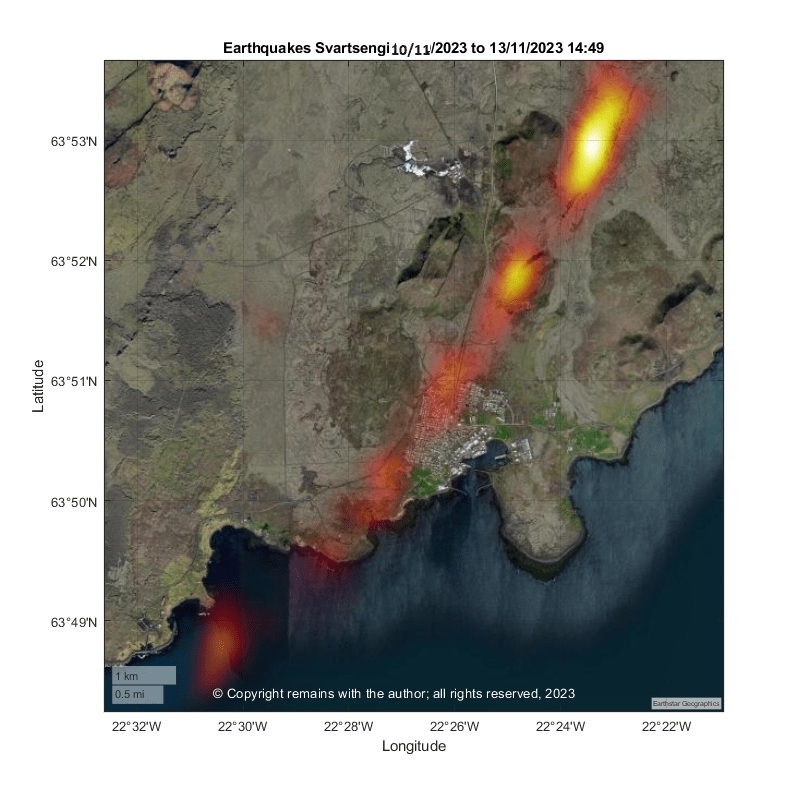
Fig 18:  Earthquake geodensity plot of the earthquakes on the Reykjanes Peninsula between 10th November 2023 and 13th November 2023.  © copyright remains with the author; all rights reserved, 2023

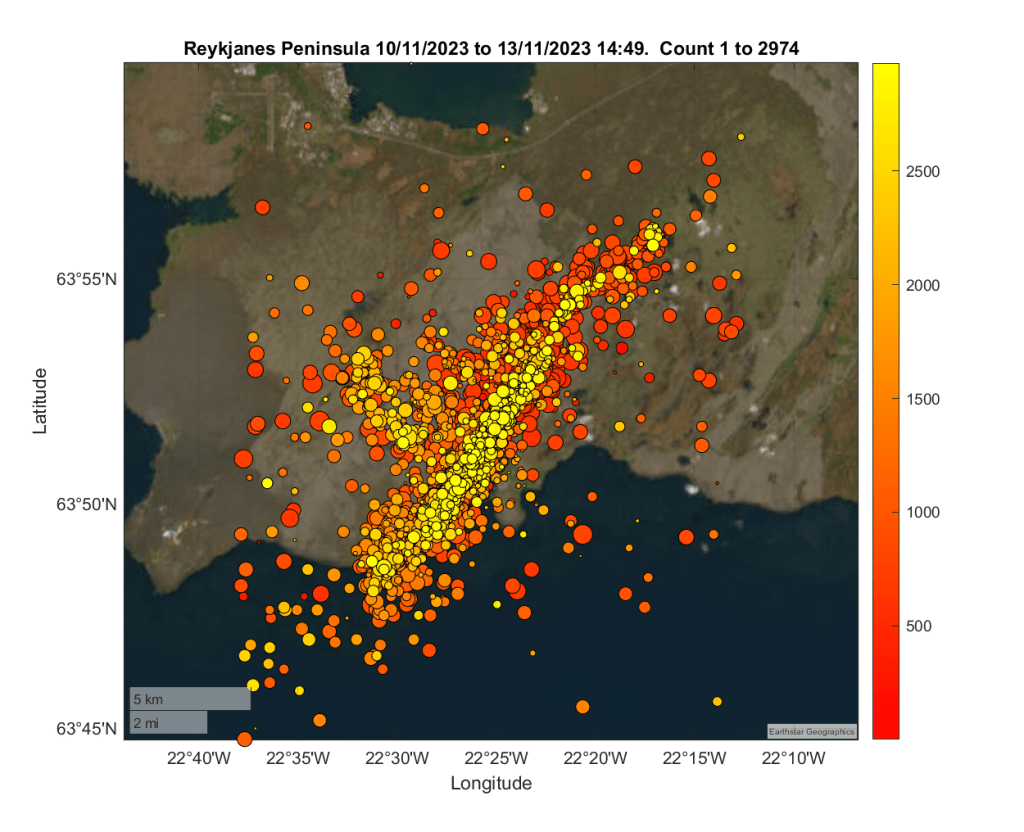
Our 3D scatter plots for the above seismic activity covered too big an area to look at the formation.  We extracted earthquakes between 63.746°N, 22.211°W and 63.996°N, 22.631°W, a total of 2,974 earthquakes.  For the 3D scatter plots only we removed a small earthquake with a depth of more than 40 km from the data set as it distorted the scale of the plots too much.

Fig 19:  Earthquake geoscatter plot of the earthquakes between 63.746°N, 22.211°W and 63.996°N, 22.631°W between 10th November 2023 and 13th November 2023.  Red denotes the earliest earthquakes; yellow denotes the latest.  The map is greater than the area plotted; the earthquakes on the edges show the borders of the area.  © copyright remains with the author; all rights reserved, 2023.
Fig 20:  Earthquake geodensity plot of the earthquakes between 63.746°N, 22.211°W and 63.996°N, 22.631°W between 10th November 2023 and 13th November 2023.  We have focussed on the area with highest density.  © copyright remains with the author; all rights reserved, 2023.
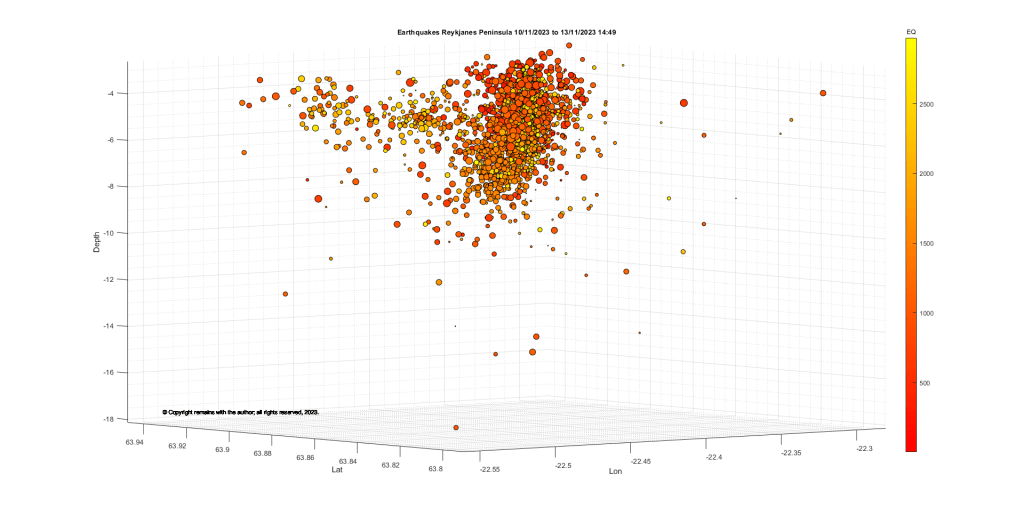
Fig  21: 3D scatter plot of earthquakes of the earthquakes between 63.746°N, 22.211°W and 63.996°N, 22.631°W between 10th November 2023 and 13th November 2023.  This view looks along the formation.  © copyright remains with the author; all rights reserved, 2023.
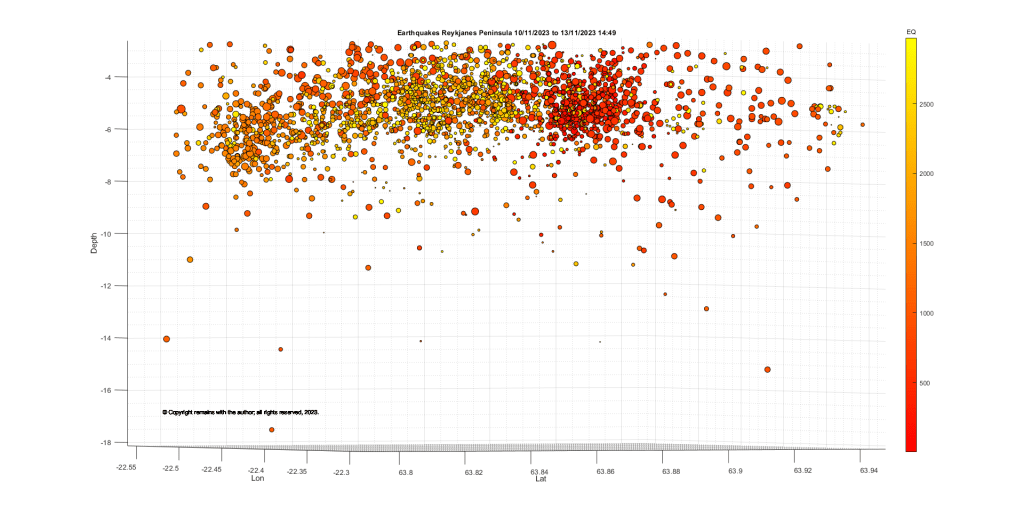
Fig 22:  3D scatter plot of earthquakes of the earthquakes between 63.746°N, 22.211°W and 63.996°N, 22.631°W between 10th November 2023 and 13th November 2023.  This view looks at the side of the formation.  © copyright remains with the author; all rights reserved, 2023.

For more recent updates, please consult the Icelandic authorities, such as IMO (link below).

Armchair Volcanolgoist

© Copyright remains with the author; all rights reserved.

Source for inform,ation and raw earthquake data: Icelandic Meteorological office (vedur.is)

Update 11th November 2023 ,18:01

IMO reported this evening that there is a significant likelihood of a volcanic eruption in the coming days. 

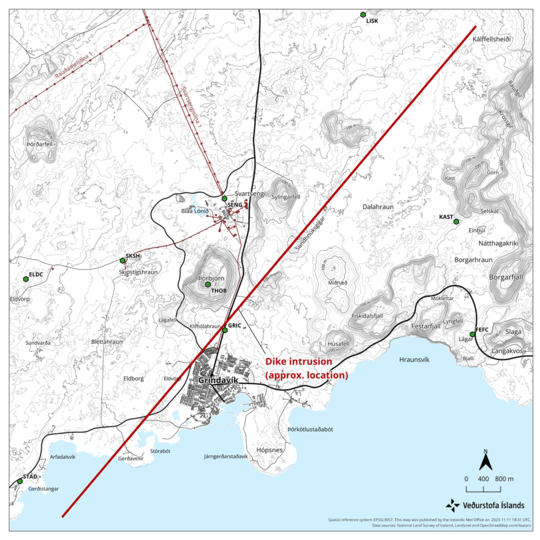
Modelling based on ground deformation and seismicity by scientists at IMO and the University of Iceland shows that there is a 15km long magma intrusion located northwest of Grindavík.  The intrusion stretches from Kálffellsheiði, northeast of Grindavík, to offshore southwest of Grindavík.

Magma has ascended to 800m below the surface. Where and when an eruption will occur cannot be predicted now – other than to say that it would most likely be in the vicinity of the intrusion, if it occurs.

Fig 12  Map showing the location of the dike intrusion based on combined satellite radar imagery, GPS measurements, and geophysical modelling. Source: IMO

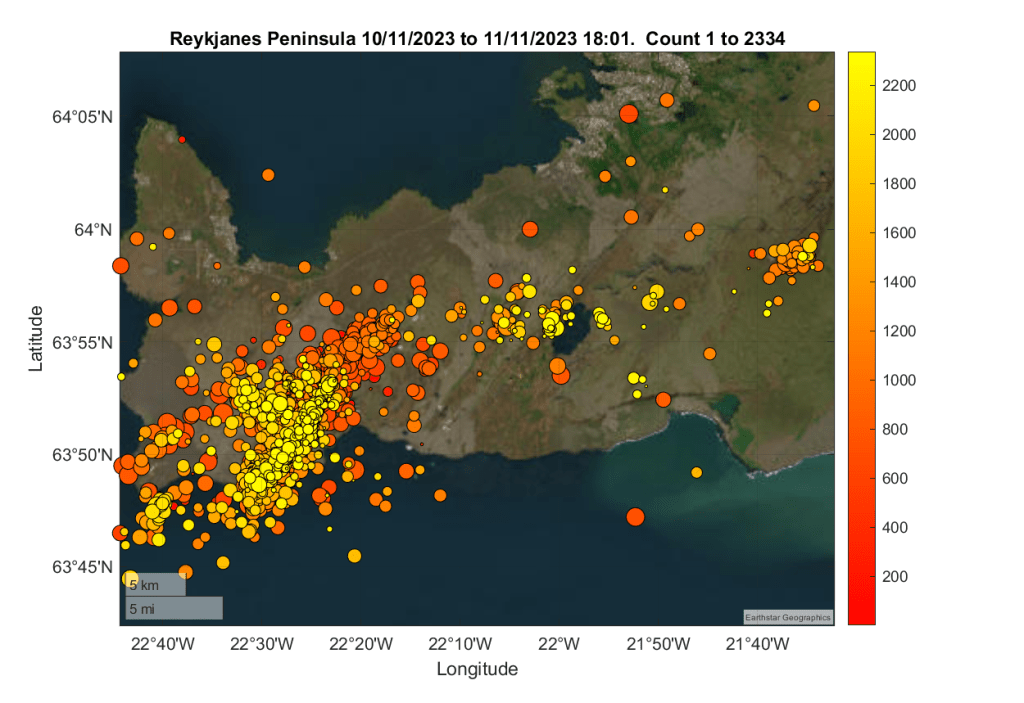
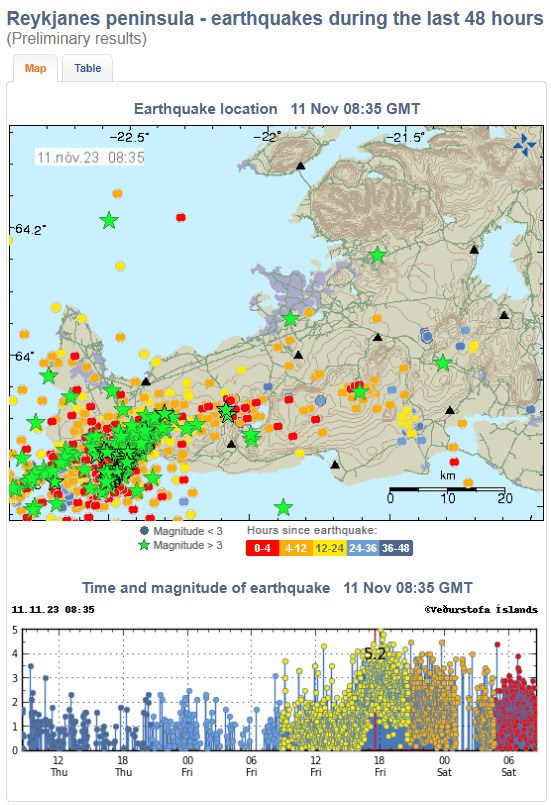
We have updated our earthquake plots for the swarm to 18:01, this time using those with more than 90% quality from IMO’s Reykjanes peninsula – earthquakes during the last 48 hours (Preliminary results) | Reykjanes peninsula | Icelandic Meteorological office (vedur.is).  The reduced quality may mean that we have picked up a few ghosts and other errors in the plots but it is reasonable enough to give an idea of what’s going on.  A total of 2,334 earthquakes were recorded at the time of our download.

Fig 13  Earthquake geoscatter plot by the author of the swarm occurring on the Reykjanes Peninsula from 10th November to 11th November 18:01.  Red denotes the earliest quakes; yellow denotes the latest quakes.  © Copyright remains with the author; all rights reserved, 2023.

The geoscatter plot has picked up the magma intrusion and faults moving to accommodate the intrusion.

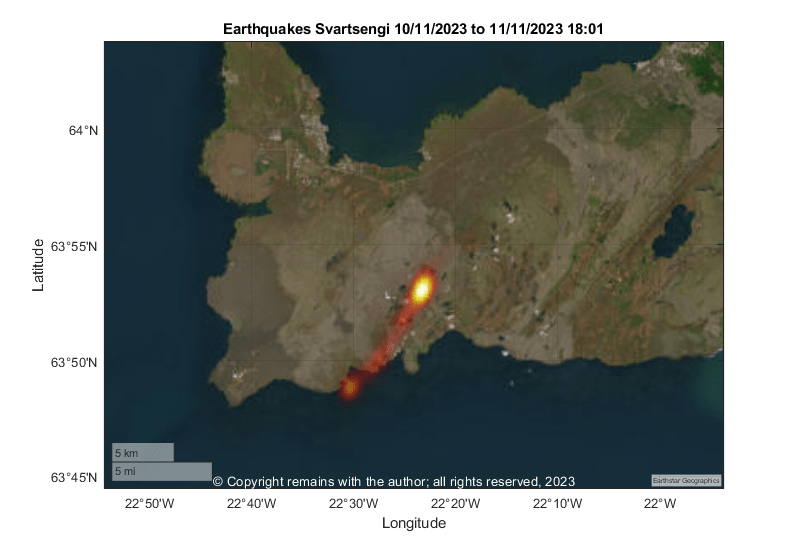
Fig  14 Earthquake geodensity plot by the author of the swarm occurring on the Reykjanes Peninsula from 10th November to 11th November 18:01.  © Copyright remains with the author; all rights reserved, 2023.

The geodensity plot shows that most earthquake activity occurring is from the magma instrusion.

Armchair Volcanologist

© Copyright remains with the author; all rights reserved, 2023.

Source for the update and raw earthquake data as before:  Icelandic Meteorological office (vedur.is)

Good morning

Update 11th November 2023 , 05:58

Since our original post below, events have moved on.  The town of Grindavík was evacuated overnight when it became apparent that a dike could be forming under the town.  The Svartsengi Power Plant will be operated remotely.

The swarm has continued relentlessly since yesterday.

Fig 8: Earthquakes on the Reykjanes Peninsula.  Note the activity is concentrated near Mount Þorbjörn; most of the outliers are ghost in the auto system.  Source: IMO.

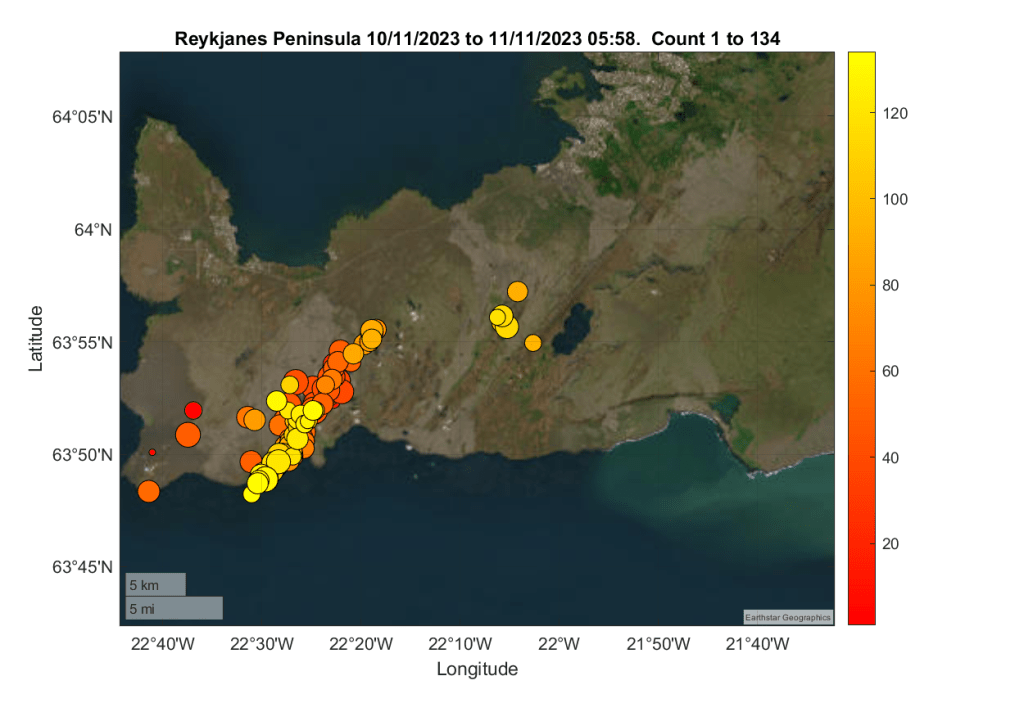
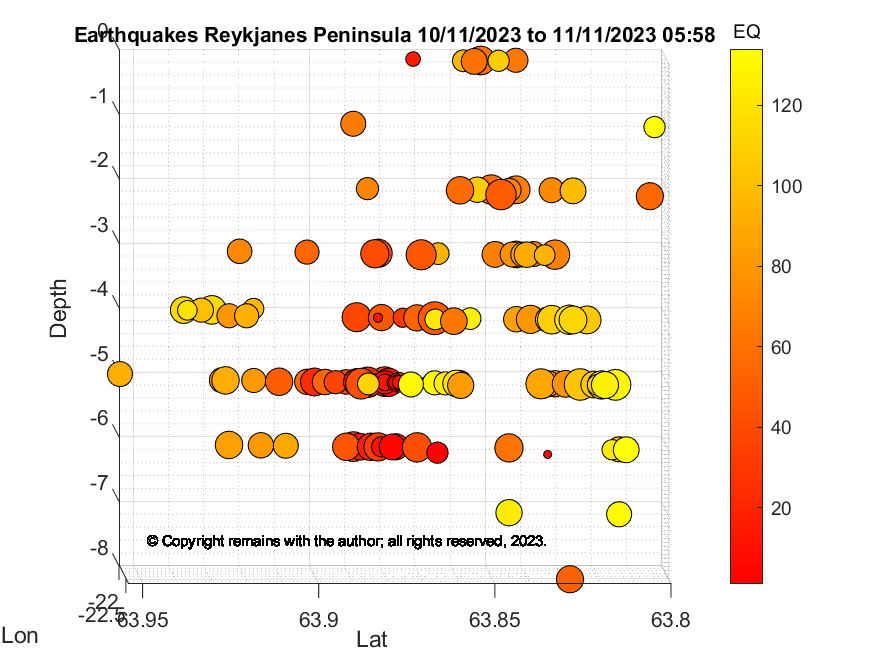
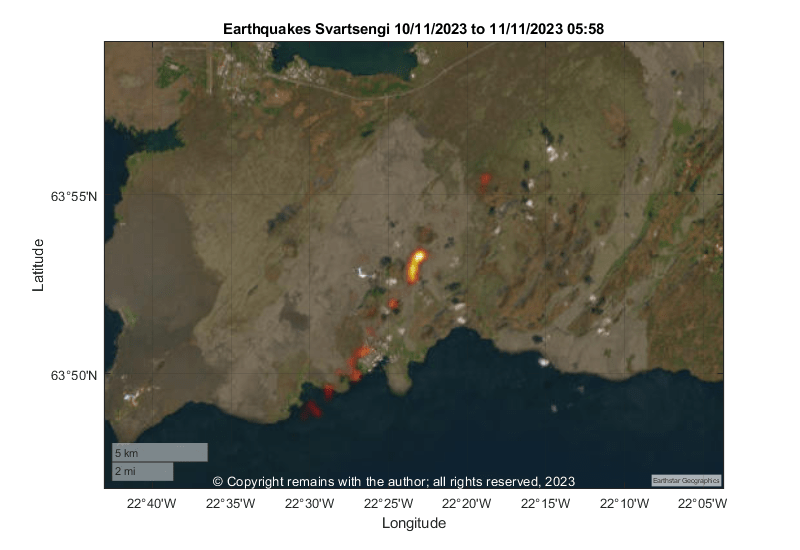
We have plotted the activity from 10th November 2023 to 11th November 2023 05:58 using the confirmed earthquakes reported on Skjálfta-Lísa (vedur.is), a total of 134 earthquakes.  Our plots show the possible dike formation. 

Fig 9: Earthquake geoscatter plot by the author of confirmed earthquakes occurring on the Reykjanes Peninsula from 10/11/2023 to 11/11/2023 05:58.  Colour denotes age (red earliest, yellow latest).  © Copyright remains with the author; all rights reserved, 2023.
Fig 10: Earthquake scatter plot by the author of confirmed earthquakes occurring on the Reykjanes Peninsula from 10/11/2023 to 11/11/2023 05:58.  Colour denotes age (red earliest, yellow latest).  Here we are looking sideways at the dike.  © Copyright remains with the author; all rights reserved, 2023
Fig 11: Earthquake geodensity plot by the author of confirmed earthquakes occurring on the Reykjanes Peninsula from 10/11/2023 to 11/11/2023 05:58.  © Copyright remains with the author; all rights reserved, 2023.

It is not possible to predict when and where an eruption may occur.  For updates, please consult the Icelandic Authorities, for example, IMO.

Armchair Volcanologist

© Copyright remains with the author; all rights reserved, 2023.

Source for raw earthquake data as before:  Icelandic Meteorological office (vedur.is)

Original Post 10/11/2023

Good evening,

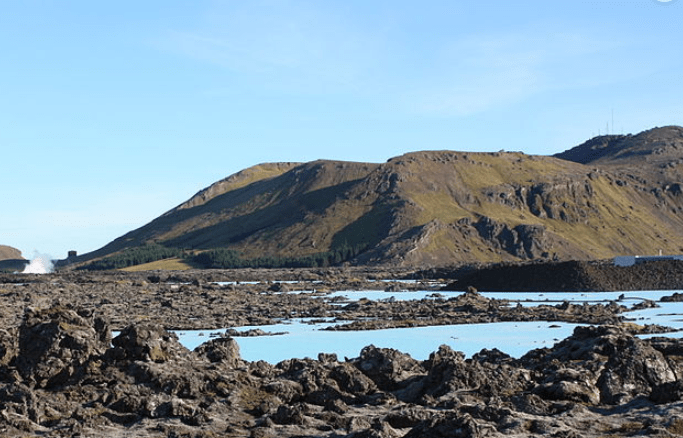
Fig 1:  Image cropped from one by Arian Zwegers of the Blue Lagoon with Mt Þorbjörn.  Published under CC BY 2.0

A large earthquake swarm started north of Grindavík, Iceland, on 24th October 2023 in the vicinity of the Svartsengi Geothermal Plant and Mount Þorbjörn.  This is the fifth time such a swarm has occurred during the volcano-tectonic episode which started on the Reykjanes Peninsula in December 2019, including the three eruptions of Fagradalsfjall.   Earlier today (10th November 2023), the swarm intensified. The aviation code for the Reykjanes – Svartsengi system has been raised to orange.

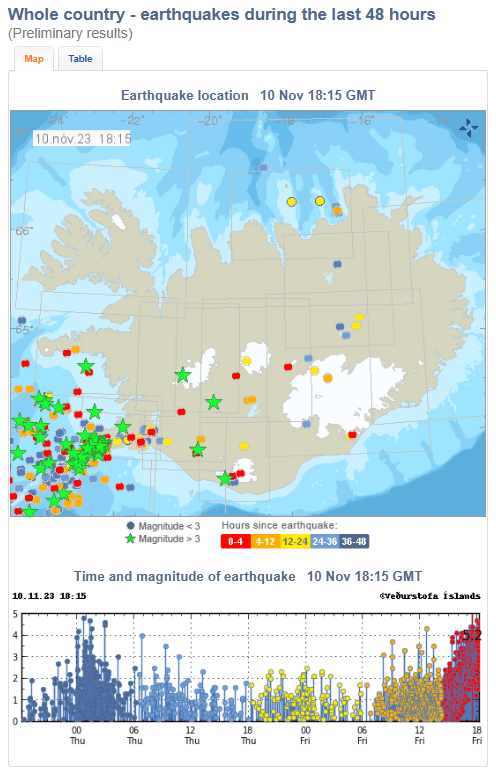
Fig 2: ongoing earthquake swarm near Svartsengi by IMO.  (Note: many of the earthquakes in the image are ghosts in the auto system; most activity is confined to the Svartsengi area). Source: Reykjanes peninsula – earthquakes during the last 48 hours (Preliminary results) | Reykjanes peninsula | Icelandic Meteorological office (vedur.is)

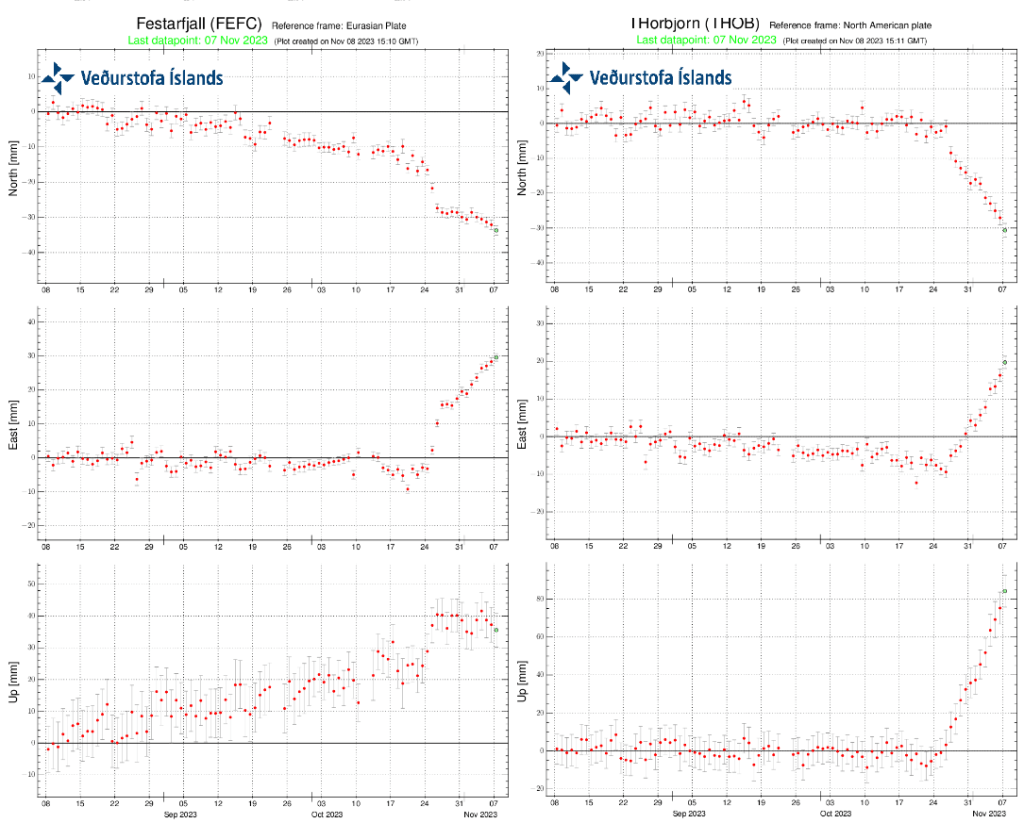
Because this activity started near Fagradalsfjall, it was initially thought that the swarm was caused by magma movement associated with Fagradalsfjall and the earthquakes to the west were triggered earthquakes (faults moving to accommodate the magma).  This was born out by initial ground deformation showing at station FEFC, southwest of Fagradalsfjall.  However, this has been followed by consistent uplift at the stations near Mt Þorbjörn, raising concerns that there is magmatic activity there.  It is believed that magma is accumulating in a sill at a depth of 5km.  Since then, there have been seven earthquakes with a magnitude greater than 4.0M in the area (as of 9th November 2023).

Fig 3:  Time series for GPS stations FEFC and Thorbjörn to 9th November 2023.  Source:  IMO.
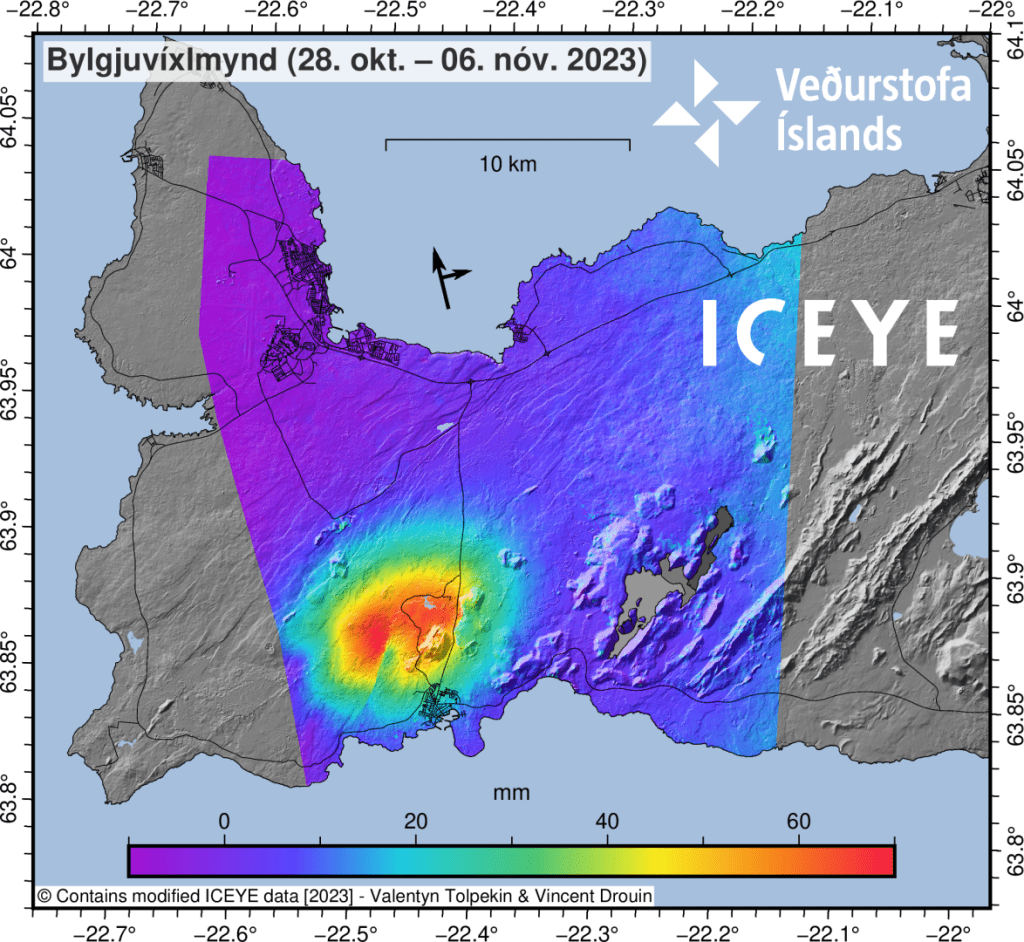
Fig 4:  Interferogram (InSAR) for the period 28th of October – 6th of November showing around 7cm ground deformation.  The green indent SW of Mt. Þorbjörn is an offset in the deformation signal caused by fault movements by earthquakes.  Source: IMO

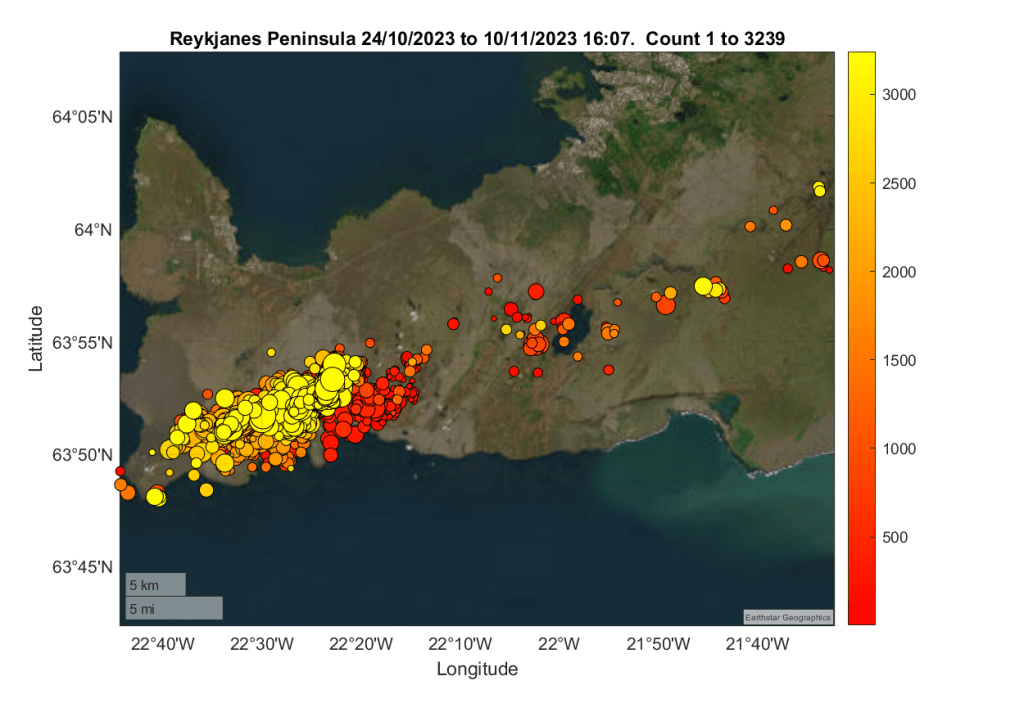
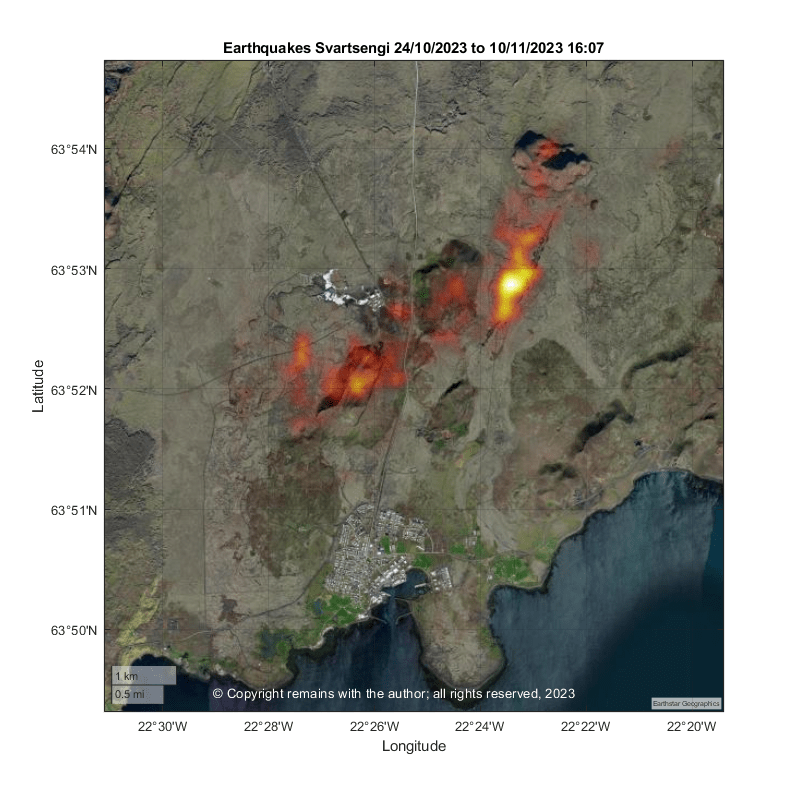
We have plotted the earthquakes reported on Skjálfta-Lísa (vedur.is)  for the Reykjanes Peninsula for the period 24th October 2023 to 10th November 2023 (16:07) to see what is going on.  3,239 earthquakes have been recorded, although many more have occurred.

The geoscatter plot shows the initial seismic activity southwest of Fagradalsfjall, followed by its migration westward.

Fig 5:  Earthquake geoscatter plot by the author for the earthquakes reported between 24th October 2023 and 10th November 2023 16:07.  © Copyright remains with the author; all rights reserved, 2023.

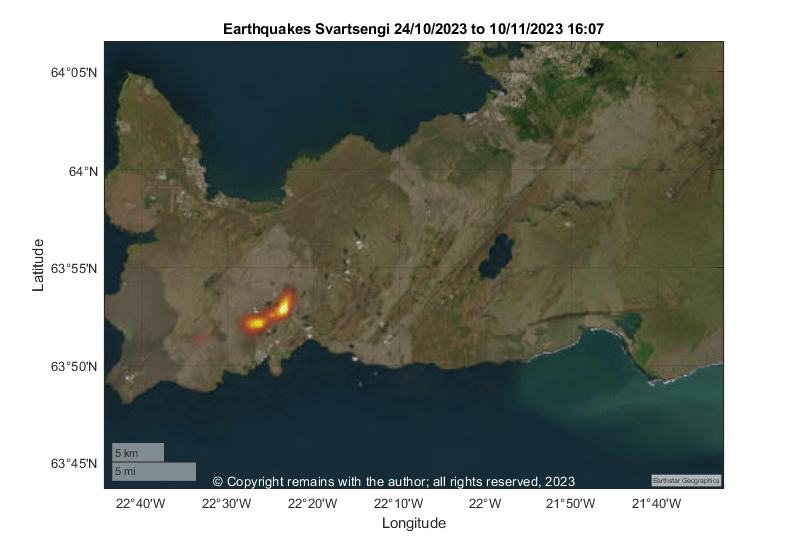
The earthquake density plot shows most activity in the vicinity of Mt Þorbjörn

Fig 6:  Earthquake density plot by the author for the earthquakes reported between 24th October 2023 and 10th November 2023 16:07.   © Copyright remains with the author; all rights reserved, 2023.
Fig 7: Close up of the earthquake geodensity plot by the author for the earthquakes reported between 24th October 2023 and 10th November 2023 13:10. The plume of steam comes from the Svartsengi Power Station, which provides electricity and hot water to the Peninsula.  Mt Þorbjörn is east of the power station. The town of Grindavík is south of the swarm.   © Copyright remains with the author; all rights reserved, 2023.

Time will tell whether an eruption ensues.  But as a precautionary measure the Blue Lagoon is now closed to visitors and the residents of Grindavík have been advised of evacuation plans.

Our plot do not include the larger recent earthquakes, including the 5M. When we get more data, we will update our plots.

Armchair Volcanologist

© Copyright remains with the author; all rights reserved, 2023.

Source: Raw earthquake data: Icelandic Meteorological office (vedur.is)

Update on the Eruption at Litli Hrútur, 13th July 2023

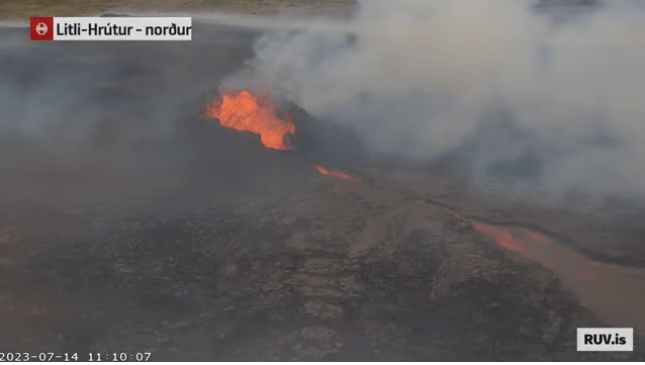
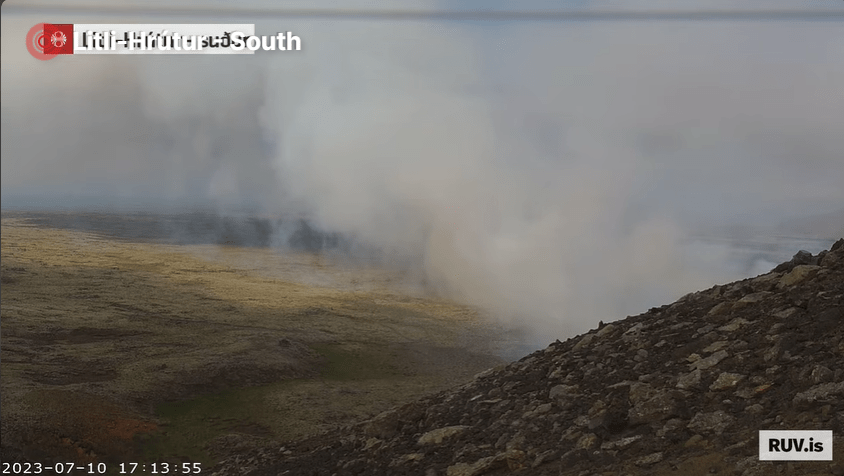
Fig 1: Screenshot from Bein streymi frá eldgosinu við Litla-Hrút – RÚV.is (ruv.is)  Lava flowing south from the crater today.  Smoke from the moss fires is visible at the edge of the lava field.

The eruption site is closed to the public right now due to the danger from volcanic gasses and smoke from moss fires; some visitors have been affected.  Also, some visitors have been taking insane risks (e.g., attempting to climb the crater wall).  High winds yesterday also caused issues.

The Institute of Earth Sciences, Iceland, have provided an update on the eruption here: Volcanic eruption at Litli-Hrút, measurement results 13 July | Institute of Earth Sciences (hi.is) .  This is summarised below.

  • As we know the eruption started on 10th July 2023 at 16:40 with the opening of four fissures with a combined length of c.800m in a north easterly direction from Litli Hrútur towards Keilir.   The eruption peaked at c.21:00, diminishing to form a single crater c. 400m northeast of Litli Hrútur.
  • Lava is flowing south with an average flow rate of 13m3/s (similar to the 2021 eruption) for the period 11 July to 13 July.  As of 13 July 13:38, the lava volume is c. 3.4 million cubic metres covering an area of 0.4km2.  Calculations were performed by NLSI from Pleiades satellite images.
  • The lava composed of vesicular glass, microphenocrysts and microlites of plagioclase, olivine, clinopyroxene and spinel, similar to the 2022 lava.  Lava is estimated to have a temperature of c.1190°C.  The chemical composition is similar to that of the 2021 and 2022 eruptions: MgO wt.% = 8.5, and, K2O/Ti2O = 0.26.
  • The gas composition is similar to that of the 2022 eruption, with a high concentration of CO2.  The CO2 may have accumulated prior to the eruption.  SO2 gas emissions range from 5.4-11.5 ktonnes / day and CO2 is 7.1 – 15 5 ktonnes / day.

If lava continues to flow southwards, it may reach the 2022 lavas in Meradalir.

We have updated our earthquake plots to 13th July 2023 02:06, focussing more on the area between Fagradalsfjall, Keilir and Krýsuvík. 

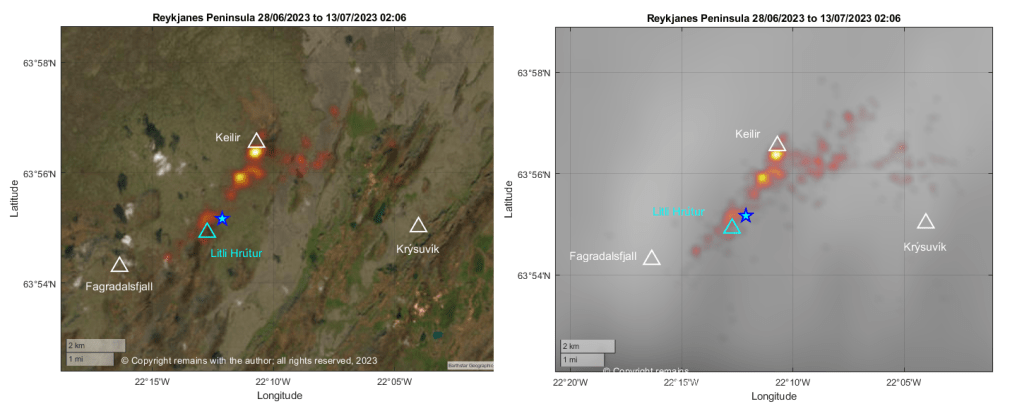
The earthquake density plot is still showing most activity southwest of Keilir and close to the eruption site, which we determined from eyeballing the location of the crater. The area southeast of Keilir is also showing more activity.  Whether the activity close to Keilir is triggered quakes, the result of faults moving to accommodate the magma intrusion, or magma-related (or, indeed, both) remains to be seen.

Fig 2: Geodensity plots by the author.  The blue star shows the approximate location of the crater. In the image to the right, we have removed the satellite image background so that the earthquakes are more visible. © Copyright remains with the author; all rights reserved, 2023. 
Fig 3:  Geoscatter plots by the author.  The blue star shows the approximate location of the crater. © Copyright remains with the author; all rights reserved, 2023. 
Fig 4:  Scatter plots by the author.  The blue star shows the approximate location of the crater. © Copyright remains with the author; all rights reserved, 2023. 
Fig 5:  Combined geoscatter & scatter plots by the author.  © Copyright remains with the author; all rights reserved, 2023. 

Armchair Volcanologist

© Copyright remains with the author; all rights reserved, 2023

Sources

Raw earthquake data: Skjálfta-Lísa (vedur.is)

Other sources are included in the text.

Eruption Started Near Litli Hrútur, Iceland

Updated for earthquake plots from 28th June 2023 to 10th July 15:04 (pre eruption) for the Reykjanes Peninsula

Fig 1: Screenshot from RUV.is webcam on Litli Hrutur. The eruption site is behind the hill. Source: https://www.ruv.is/frettir/innlent/2023-07-06-beint-streymi-fra-fagradalsfjalli-387091

The Icelandic Met Office has confirmed the onset of an eruption on the eastern and northeastern flanks of Litli Hrútur, Iceland. The eruption started around 16:40 today with the opening of three small fissures on a 200m fault. Lava is collecting in a depression then flowing southwards, with gas and steam emissions going northwestwards.

Fig 2: Image by  Benedikt Ófeigsson from IMO’s facebook page showing the two fissures. Image appears to have been taken from Lilti Hrútur. Source: https://www.facebook.com/photo/?fbid=701454135343917&set=a.312131834276151

Images taken by Jakob Vegerfors, which he posted onto Facebook, show two initial fissures. The images can be found here: https://www.facebook.com/photo?fbid=10159116738742038&set=pcb.1442657949904754 The hill in the left foreground is Litli Hrutur and the larger hill to the right in the background is Kelir.

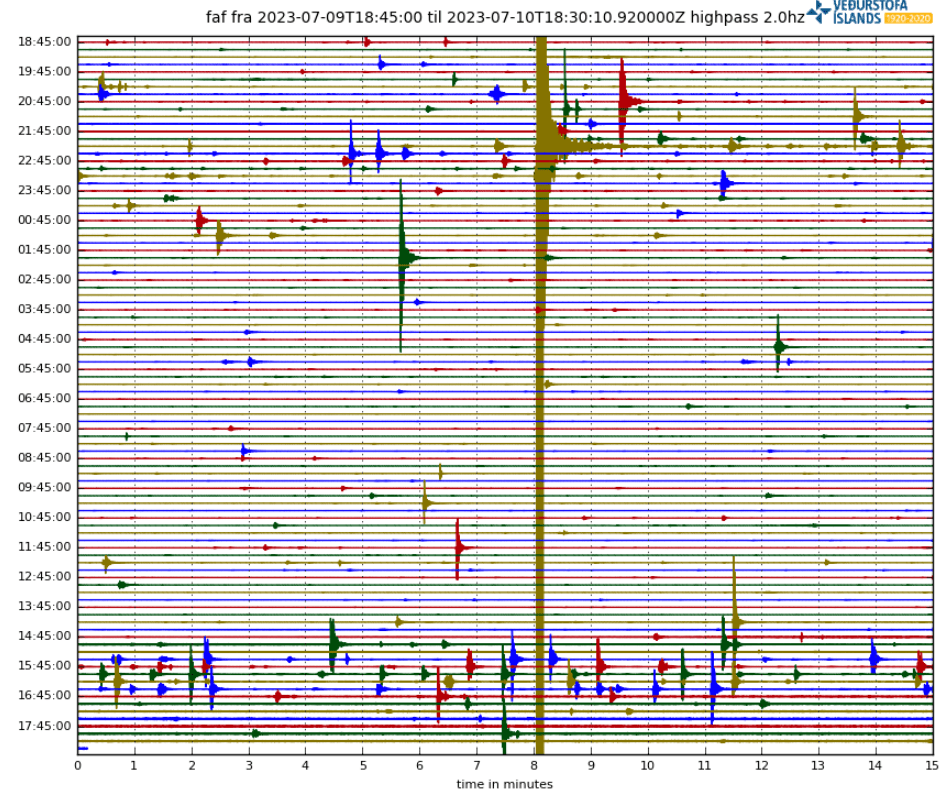
IMO reported noticing a disturbance on the earthquake station at Fagradaslfjall last night and again at 14:00 today similar to those preceding the 2021 and 2022 eruptions.

Fig 3: Helicorder plot for Fagradalsfjall today. Source: IMO

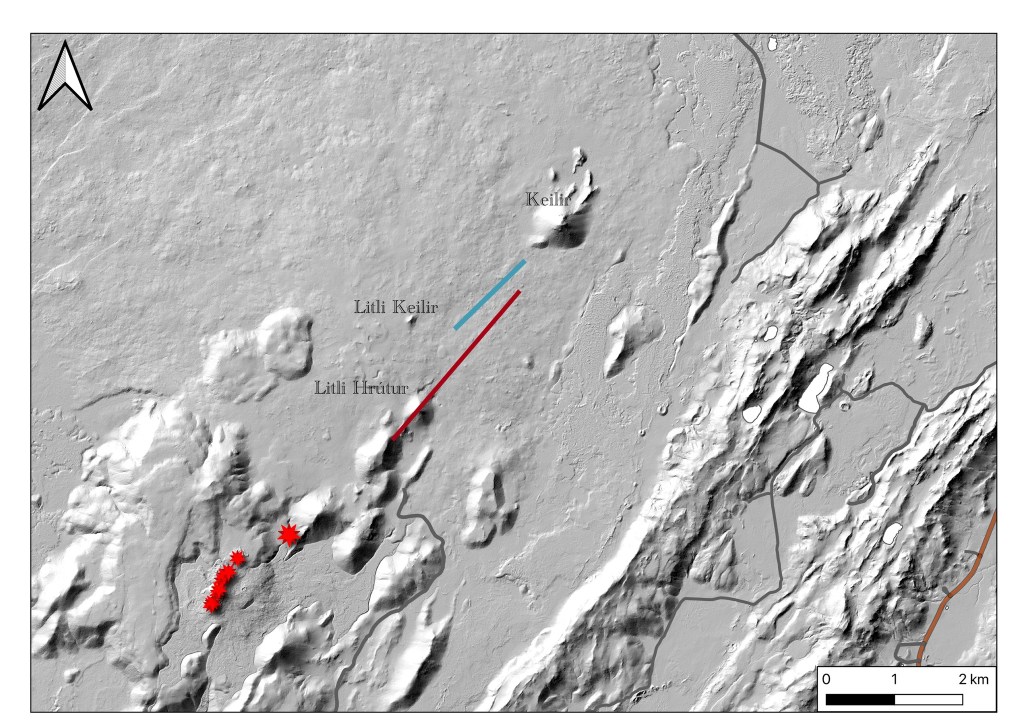
The eruption site appears to be a little east of the southern end of the calculated position of the dyke intrusion.

Fig 4: Calculated position of the dyke instrusion (red line) from IMO. Red stars show the position of earlier eruptions (2021 and 2022). The blue line is the location of surface deformation from ICEYE wave interference images taken 7-8 July. Location of surface fracture and insert model determined by Michelle M. Parks and Vincent Droin, Icelandic Meteorological Office. Photo: Ásta Rut Hjartardóttir, University of Iceland

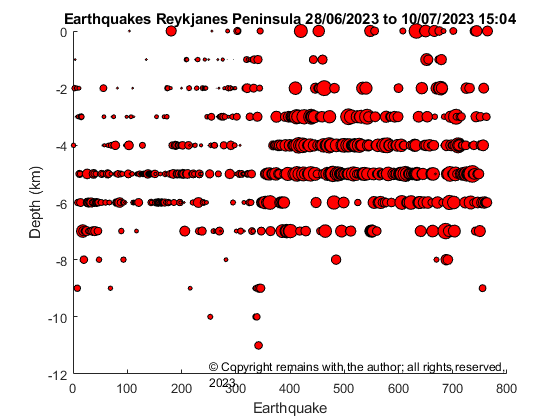
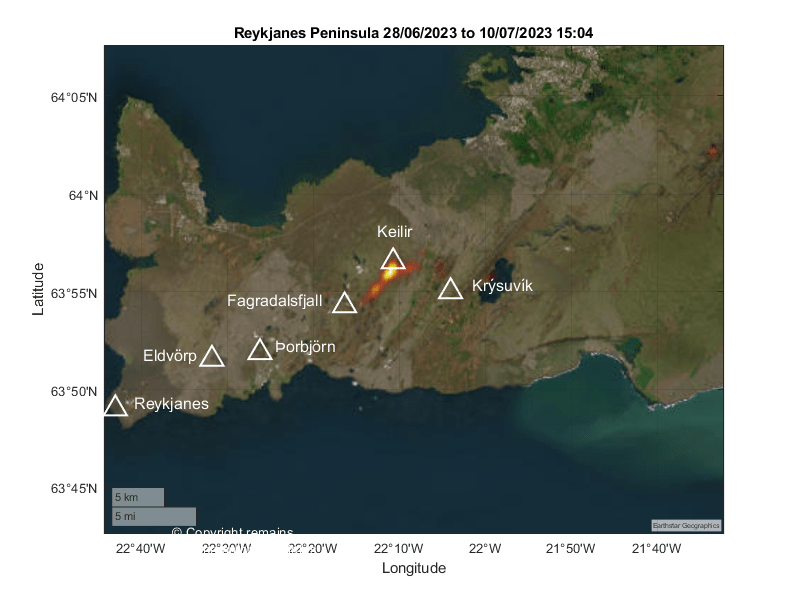
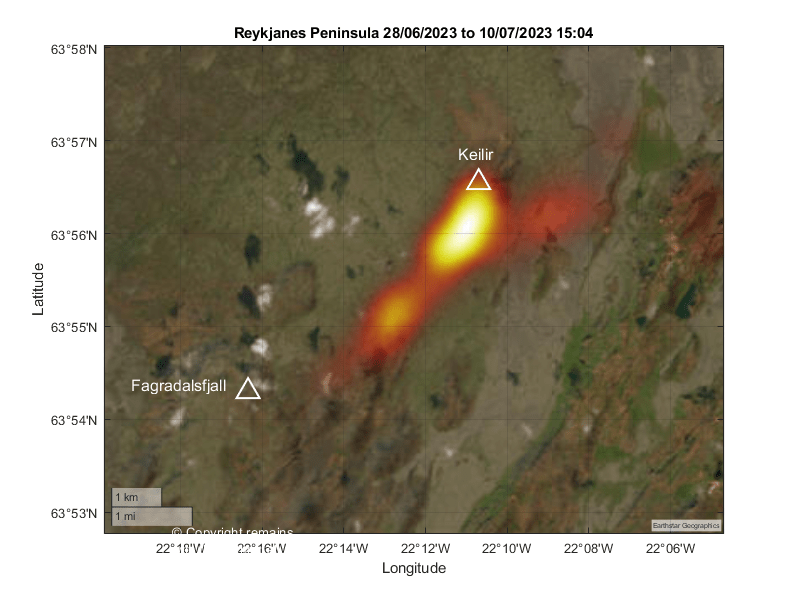
We have updated our earthquake plots from 28th June 2023 to 10th July 2023 15:04 for the Reykjanes Peninsula. We used the 764 confirmed earthquakes published by IMO on https://skjalftalisa.vedur.is/#/page/map. The total number of earthquakes in the swarm was c.12,000 as of 9th July 2023.

Fig 5: Geoscatter plots by the author for 28th June 2023 to 10th July 2023 15:04. Colour denotes age: red is the oldest, yellow the youngest.  © Copyright remains with the author; all rights reserved, 2023
Fig 6: Scatter plots by the author for 28th June 2023 to 10th July 2023 15:04. Colour denotes age: red is the oldest, yellow the youngest.  © Copyright remains with the author; all rights reserved, 2023
Fig 7: Scatter plots by the author of quake v depth for 28th June 2023 to 10th July 2023 15:04. Size denotes magnitude.  © Copyright remains with the author; all rights reserved, 2023
Fig 8: Geodensity plots by the author for 28th June 2023 to 10th July 2023 15:04. © Copyright remains with the author; all rights reserved, 2023
Fig 9: Zoomed in geodensity plot by the author for 28th June 2023 to 10th July 2023 15:04. © Copyright remains with the author; all rights reserved, 2023

Apparently the eruption site is difficult to get to. If you intend to visit, please follow the advice of the local authorities and stay safe.

For local news sources, try

IMO: https://en.vedur.is/ and their Facebook page, https://www.facebook.com/Vedurstofan

RUV.is: https://www.ruv.is/frettir

MBL.is: https://www.mbl.is/frettir/

For local webcams, try

https://www.ruv.is/frettir/innlent/2023-07-06-beint-streymi-fra-fagradalsfjalli-387091

Armchair Volcanologist

© Copyright remains with the author; all rights reserved, 2023.

Update on July 2023 Earthquake Swarm Fagradalsfjall to Kelir as at 7th July 2023 18:23

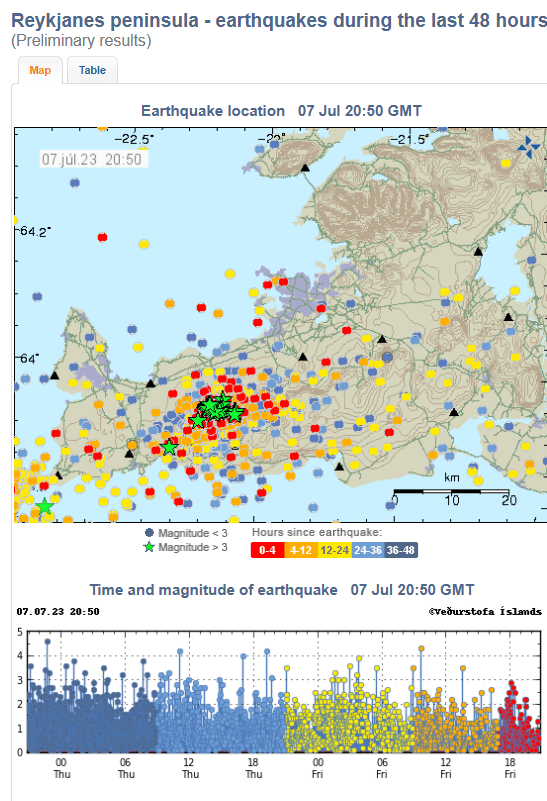
The earthquake swarm which started on 4th July 2023 is continuing vigorously as we write, with 7,000 earthquakes detected.  InSAR has confirmed that there is a dike intrusion between Fagradalsfjall and Kelir. IMO have said that magma is likely to have reached a depth of around 1 km by 6th July, causing a fracture of a 2.8 km length between Fagradalsfjall and Keilir, centred a little north of Litli-Hrútur. The expectation is that, if an eruption occurs, it will be in hours or days. The eruption may be short but bigger in its initial stages than the 2021 and 2022 eruptions. The alert level remains at orange.

A smaller swarm is also ongoing southwest of the peninsula on the Reykjanes ridge, near the island of Eldey.  This may be due to crustal accommodation of the magma intrusion between Fagradalsfjall and Kelir and/or it may be independent activity.  The alert level has been raised to yellow. We will look at this in later posts.

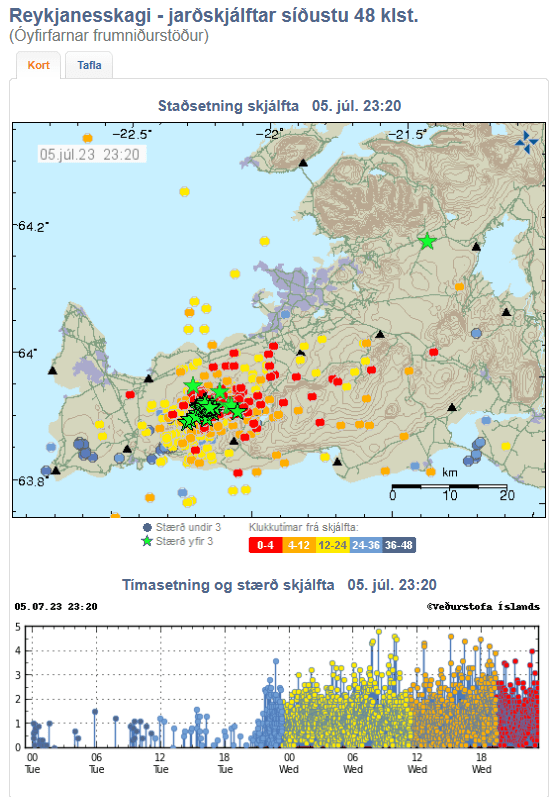
Fig 1: Earthquake map and plot of earthquake magnitude v time from IMO (preliminary results only).  Magnitude is decreasing, following the pattern of the 2021 and 2022 eruptions. Many of the “quakes” scattered over the peninsula and environs are ghosts.  Source: Reykjanes peninsula – earthquakes during the last 48 hours (Preliminary results) | Reykjanes peninsula | Icelandic Meteorological office (vedur.is)
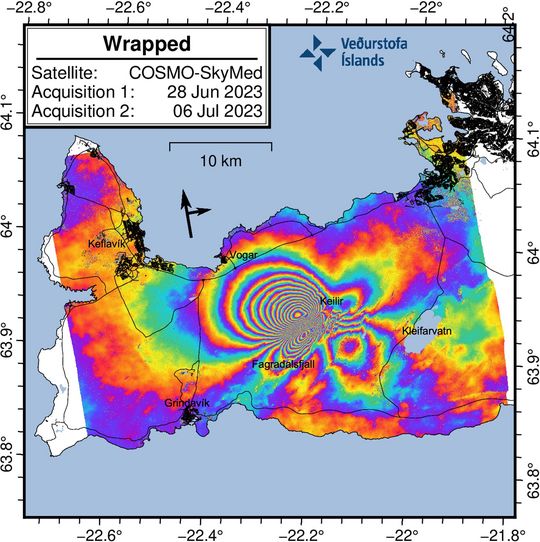
Fig 2: InSAR image confirming dike intrusion.  See main text for attribution and description.

From IMO, Earthquake activity in Fagradalsfjall area | News | Icelandic Meteorological office (vedur.is), “COSMO-SkyMed interferogram covering the period 28 June to 6 July 2023.

The wrapped image (Fig 2) clearly shows a series of multicolored fringes centered bewtween Fagradalsfjall and Keilir. These fringes show ground deformation caused by the new dike intrusion which commenced on 4 July 2023. The maximum observed deformation related to the dike intrusion is up to 18 cm in the satellite‘s line-of-sight (los) in the NW direction.

Although the deformation signal extends over a large area of the western Reykjanes Peninsula, this does not mean there is magma beneath this entire region. The magma intrusion is situated bewteen Fagradalsfjall and Keilir. There is no indication of additional magma movements outside this area.

Several small lineaments are also visible in the interferogram which cut across the fringes. These represent fault movements/earthquakes that were triggered during the dike propagation.”

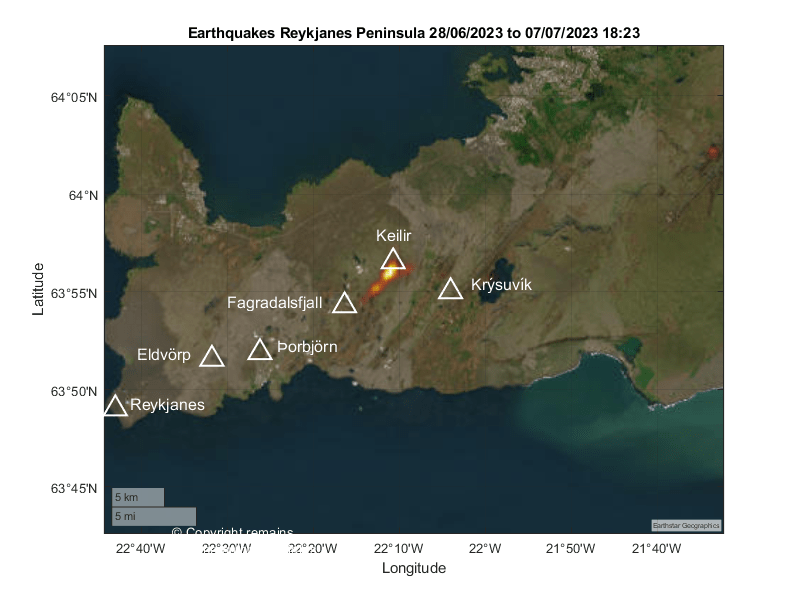
We have updated our earthquake plots to this morning, 7th July 2023 09:37 using the published earthquakes from https://skjalftalisa.vedur.is . 

Fig 3: Geoscatter plot by the author of earthquakes occurring in the current swarm on the Reykjanes Peninsula. © Copyright remains with the author; all rights reserved, 2023
Fig 4: Scatter plot by the author of earthquakes occurring in the current swarm on the Reykjanes Peninsula. © Copyright remains with the author; all rights reserved, 2023
Fig 5: Geodensity plot by the author of earthquakes occurring in the current swarm on the Reykjanes Peninsula. © Copyright remains with the author; all rights reserved, 2023.

Fig 5: Geodensity plot by the author of earthquakes occurring in the current swarm on the Reykjanes Peninsula. © Copyright remains with the author; all rights reserved, 2023.

Time will tell whether and where lava emerges with the current swarm.

Our thanks go again to the Icelandic Met Office, IMO, https://www.vedur.is/, for the raw earthquake data. For updates, please visit IMO.

Armchair Volcanologist

© Copyright remains with the author; all rights reserved, 2023

Earthquake Swarm on the Reykjanes Peninsula, 4th July 2023 to 5th July 2023.

An earthquake swarm started on the Reykjanes Peninsula, Iceland, on 4th July 2023. It is still on progress at the time of writing.

Fig 1: Earthquake swarm on the Reykjanes Peninsula. Source: https://www.vedur.is/skjalftar-og-eldgos/jardskjalftar/reykjanesskagi/

Local volcanologist have said that the likelihood of an eruption in a matter of hours or days has increased. The aviation alert level has been increased to orange.

So we have plotted the published earthquakes from https://skjalftalisa.vedur.is from 28th June 2023 to 5th July 2023 20:16 to see what is going on.

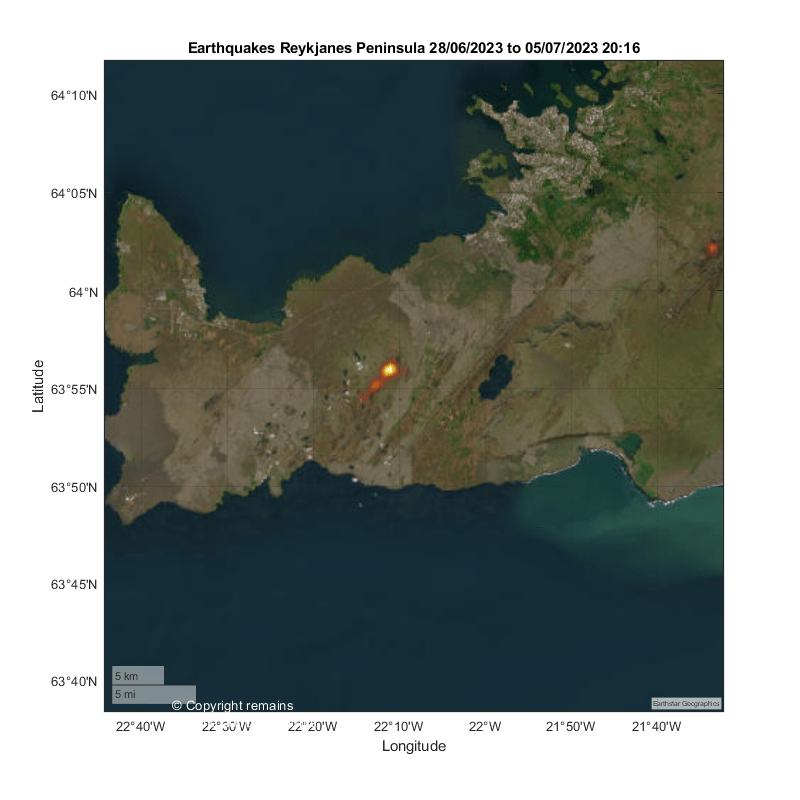
Fig 2: Geoscatter plot by the author of earthquakes occurring in the current swarm on the Reykjanes Peninsula. © Copyright remains with the author; all rights reserved, 2023
Fig 3: Scatter plot by the author of earthquakes occurring in the current swarm on the Reykjanes Peninsula. © Copyright remains with the author; all rights reserved, 2023
Fig 4: Geodensity plot by the author of earthquakes occurring in the current swarm on the Reykjanes Peninsula. © Copyright remains with the author; all rights reserved, 2023

It certainly looks like a magma intrusion close to the sites of the recent Fagradalsfjall eruptions. Time will tell whether or not and where lava emerges with the current swarm.

Our thanks go again to the Icelandic Met Office, IMO, https://www.vedur.is/, for the raw earthquake data. For updates, please visit IMO.

Armchair Volcanologist

© Copyright remains with the author; all rights reserved, 2023

Eruption at Meradalir, Iceland, Stalled 21st August 2022

Eruptive activity at the new fissure in Meradalir stalled on 21st August 2022 at around 6:00 am.  The seismic tremor ceased following the emission  of a blue grey plume.  Lava was seen on webcams to be still flowing from the crater just before then.  We await to see whether or not this is the end of this eruptive episode.

Fig 1:  Tremor plot for Fagradalsfjall.  Source: Tremor (vedur.is)

To quote IMO, “A new chapter is about to begin in the Fagradalsfjall fires, but whether the seismic activity will recur and it will erupt again in the near future or not, time will tell.”

What do we know of the eruption so far?  The eruption started on 3rd August 2022.  The initial discharge rate was c. 32 cubic metres per second, dwindling to 2 cubic metres per second by 16th August 2022. The total volume of lava emitted by 16th August 2022 was 12 million cubic metres, c. 8% of that emitted by the Geldingadalir eruption last year. At the crater the lava is 20 to 30 metres deep and 40 metres deep by the crater rims, themselves.  Over the rest of the lava field the lava is between 5 and 15 metres deep.  The new lava has displaced cooling older lava causing it to rise by 3 to 5 metres in places.

Fig 2: Lava fields 2021 and 2022.  Source: Eldgos í Meradölum | Jarðvísindastofnun – Institute of Earth Sciences (hi.is)
Armchair Volcanologist

The lava composition is similar to the basalt emitted by Geldingadalir in September 2021. The K2O / TiO2 ratio ranges from 9.3 to 9.4 and the MgO is around 8.4 wt(%).

Armchair Volcanologist

© Copyright remains with the author; all rights reserved, 2022.

Sources: in the text

A New Eruption Near Fagradalsfjall, Iceland, Started 3rd August 2022

So, it was hours, not days!  The eruption started near Fagradalsfjall / Meradalir yesterday at around 13:18 about 1.5 km north of Stóra-Hrut on a north-easterly southwest fissure.  The onset was detected by a local webcam and later confirmed by scientists. The alert level is currently orange (Volcanic eruption is underway with no or minor ash emission.)

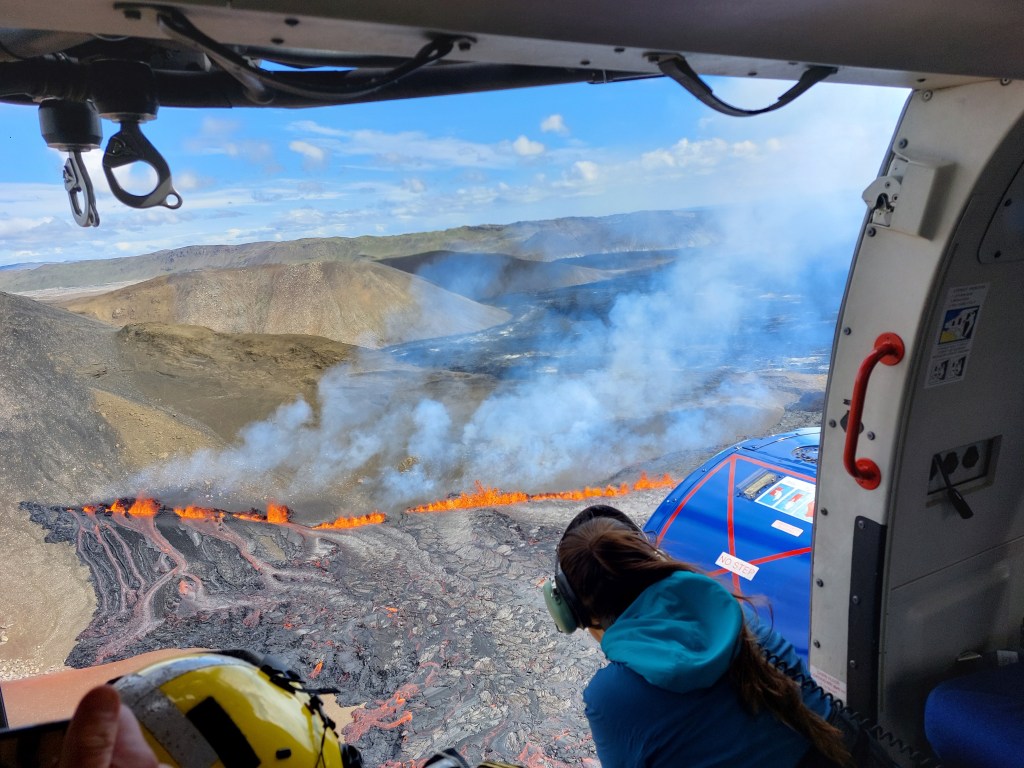
Fig 1:  Image of the new fissure taken by Halldór Björnsson at the Icelandic Meteorological Office on a flight over the eruption site on 03.08.2022.  Source:  Volcanic eruption resumed on the Reykjanes Peninsula | News | The Icelandic Meteorological Office (vedur.is)

Like the previous eruption, lava is contained by the local geography so no infrastructure is currently threatened.  Gas emissions are, however, a hazard.  The lava flow is estimated to be 5 – 10 times that of Geldingadalir at 32 cubic meters per second in the first 24 hours; gas emissions may well be similarly larger.

Fig 2:  The red line shows the location of the new fissure on the northern edge of the lava flow from the 2021 eruption. The 2021 eruption was located near “Fagradalshraun” on the map. Source: Volcanic eruption resumed on the Reykjanes Peninsula | News | The Icelandic Meteorological Office (vedur.is)

Visitors are advised not to approach the site at the moment. When the site is open, bear in mind that it is not an easy walk, so for the fit only, and visitors should be properly prepared, including having gas masks and metres.

A video made by Reykjanes Grapevine shows the eruption site yesterday: RVK Newscast #203: New Volcanic Eruption In Iceland – YouTube

Seismic activity has decreased since the onset of the eruption.  We have now updated our earthquake plots to 4th August 2022 10:27- see below.

Updated earthquake plots

At the time of updating, we did not have confirmation of the coordinates of the eruption site, so we have guessed based on maps of the fissure. The plots will be updated when more up to date information becomes available.

Fig 4: Earthquake density plot of the swarm from 29th July 2022 to 4th August 2022 10:27 by the author showing how close the eruption site is to the densest parts of the current swarm. © Copyright remains with the author; all rights reserved, 2022
Fig 5: Scatter plot depth v earthquake number in the swarm from 29th July 2022 to 4th August 2022 10:27 by the author. © Copyright remains with the author; all rights reserved, 2022
Fig 6: Video by the author of geoscatter plots and 3D scatter plots of the swarm from 29th July 2022 to 4th August 2022 10:27. © Copyright remains with the author, all right reserved, 2022

Happy volcano watching and stay safe.

Armchair Volcanologist

© Copyright remains with the author; all rights reserved, 2022

Sources: within the text

A New Earthquake Swarm Near Fagradalsfjall, Iceland, Started 30th July 2022 – Updated

Updated 04/08/2022, Fagradalsfjall

A new eruption started at c13:18 yesterday, 3rd August 2022. We are following this on a new thread, A New Eruption Near Fagradalsfjall, Iceland, Started 3rd August 202.

Update 02/08/2022, 20:39:46, Fagradalsfjall and Grímsvötn

The earthquake swarm near Fagradalsfjall continues unabated.  The aviation code for Grímsvötn has been raised to yellow following increased seismic activity there.

Fagradalsfjall

At the time of writing IMO were reporting 3,000 earthquakes in the last 48 hours detected by the SIL Seismic Network. 

Rising magma has caused some large triggered earthquakes where existing faults slip to accommodate the strain, the largest so far being 5.47 on day 2 of the swarm. 

The Icelandic media are reporting that new satellite images taken on 1 August 2022 show magma movements located between Fagradalsfjall and Keilir. The magma intrusion is shallow at c. 1 km below the surface. The magma influx is close to double the rate of the previous eruption. The chances of an eruption near Fagradalsfjall in the coming days or weeks have therefore increased and are considered to be significant.

We have updated our earthquake plots using confirmed earthquake data from IMO’s Skjálfta-Lísa for the area 63.75°N, 23.0°W to 64.0°N, 22°W (the western Reykjanes Peninsula).  The geodensity plot shows that most of the action is centred north east of Fagradalsfjall.

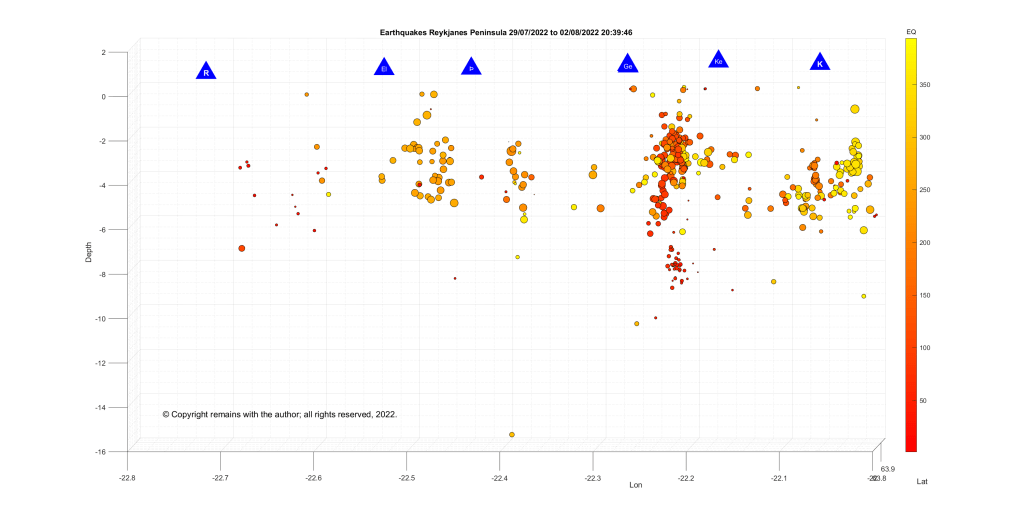
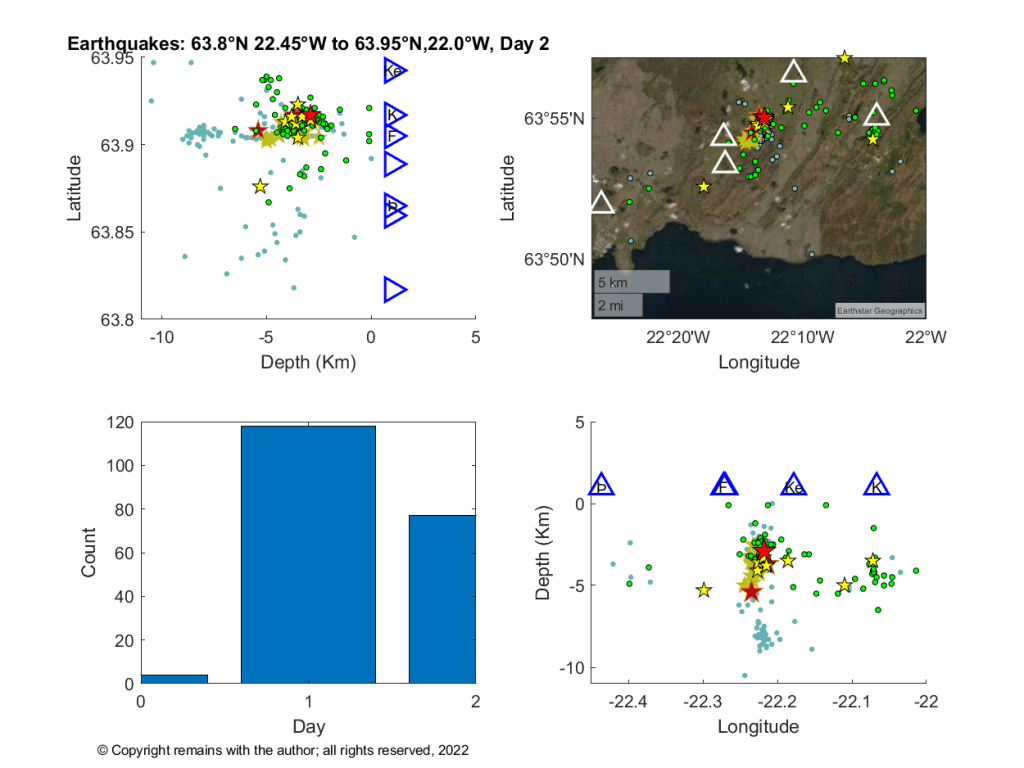
Fig 4a: Geoscatter, Latitude v Depth and Depth v Longitude and Count v Day plots by the author.  Green (grey) dots denote earthquakes less than 3.0M, yellow (old gold) stars denote earthquakes between 3.0M and 4.0M, red (wine) stars those between 4.0M and 5.0M and black (dark grey) stars those over 5.0M for the current day 2 (cumulative prior days). © Copyright remains with the author, all rights reserved, 2022.
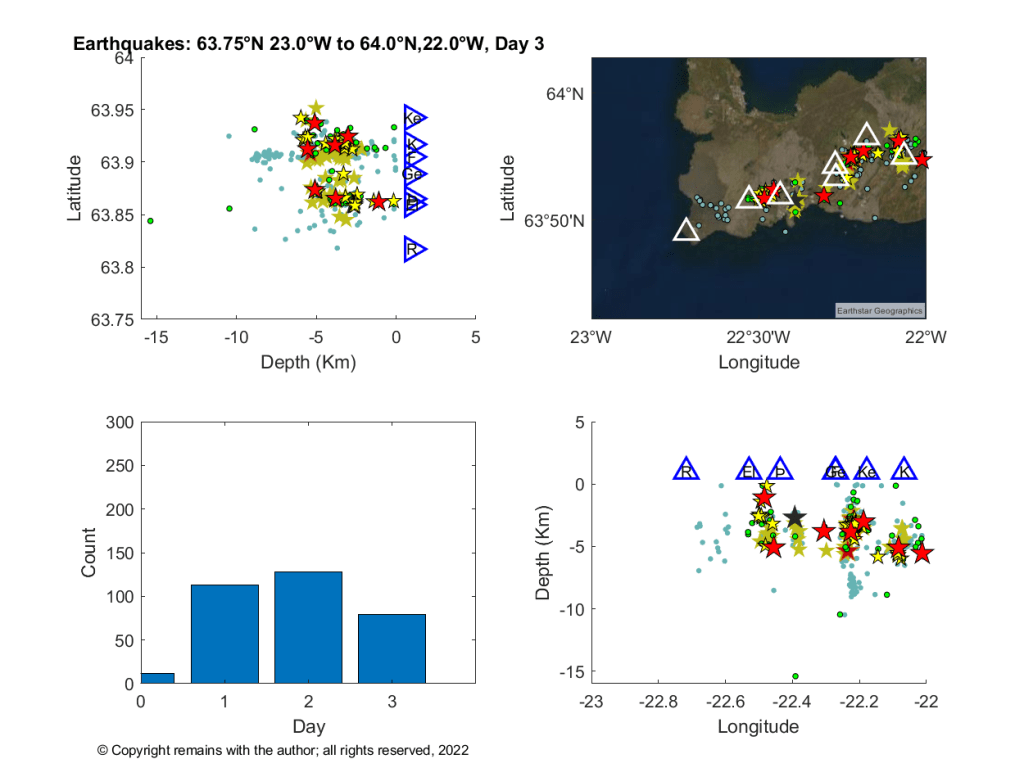
Fig 4b: Geoscatter, Latitude v Depth and Depth v Longitude and Count v Day plots by the author.  Green (grey) dots denote earthquakes less than 3.0M, yellow (old gold) stars denote earthquakes between 3.0M and 4.0M, red (wine) stars those between 4.0M and 5.0M and black (dark grey) stars those over 5.0M for the current day 3 (cumulative prior days). © Copyright remains with the author, all rights reserved, 2022.
Fig 4c: Geoscatter, Latitude v Depth and Depth v Longitude and Count v Day plots by the author.  Green (grey) dots denote earthquakes less than 3.0M, yellow (old gold) stars denote earthquakes between 3.0M and 4.0M, red (wine) stars those between 4.0M and 5.0M and black (dark grey) stars those over 5.0M for the current day 4 (cumulative prior days). © Copyright remains with the author, all rights reserved, 2022.
Fig 5: 3-dimension scatter plot by the author.  Colour denotes earthquake number in the swarm (red the oldest and yellow the newest). © Copyright remains with the author, all rights reserved, 2022
Fig 6: Geodensity plot by the author. © Copyright remains with the author, all rights reserved, 2022.

Grímsvötn

The image from IMO below shows the earthquake activity at Grímsvötn.

Fig 7: Screenshot of seismic activity at Grímsvötn today.  Source: Vatnajökull (vedur.is)

Hopefully, eruptions are not like buses – wait for ages, then several show up together.  On a more serious note, if Grímsvötn does erupt, ash may be problematic for Europe depending on the size of the eruption and the prevailing wind direction. A jökulhlaup caused by melting of the ice-cap is another hazard. An eruption near Fagradalsfjall is less likely to produce a lot of ash unless magma encounters an aquifer or other body of water; lava and any gas emissions depending on volume and location are likely hazards. Seismic activity remains a hazard for both; the public are advised of the risk of rockfall and landslip.

Armchair Volcanologist

© Copyright remains with the author, all rights reserved, 2022.

Source:

Raw earthquake data: Skjálfta-Lísa

News report: Kvikugangurinn liggur mjög grunnt | RÚV (ruv.is)

Original post 31/07/2022

A large earthquake swarm started yesterday (30/07/2022) lunchtime north east of Fagradalsfjall, Iceland.  At the time of writing, IMO had reported 1,597 earthquakes in the last 48 hours for the Reykjanes Peninsula from the SIL seismic network. This network automatically detects and locates earthquakes in Iceland and the surrounding offshore region. 199 of these earthquakes had been confirmed.

At the moment the swarm is being likened to the swarm in December 2021, which did not result in an eruption.  The local authorities are warning of the increased risk of rockfall as a result of increased seismic activity.

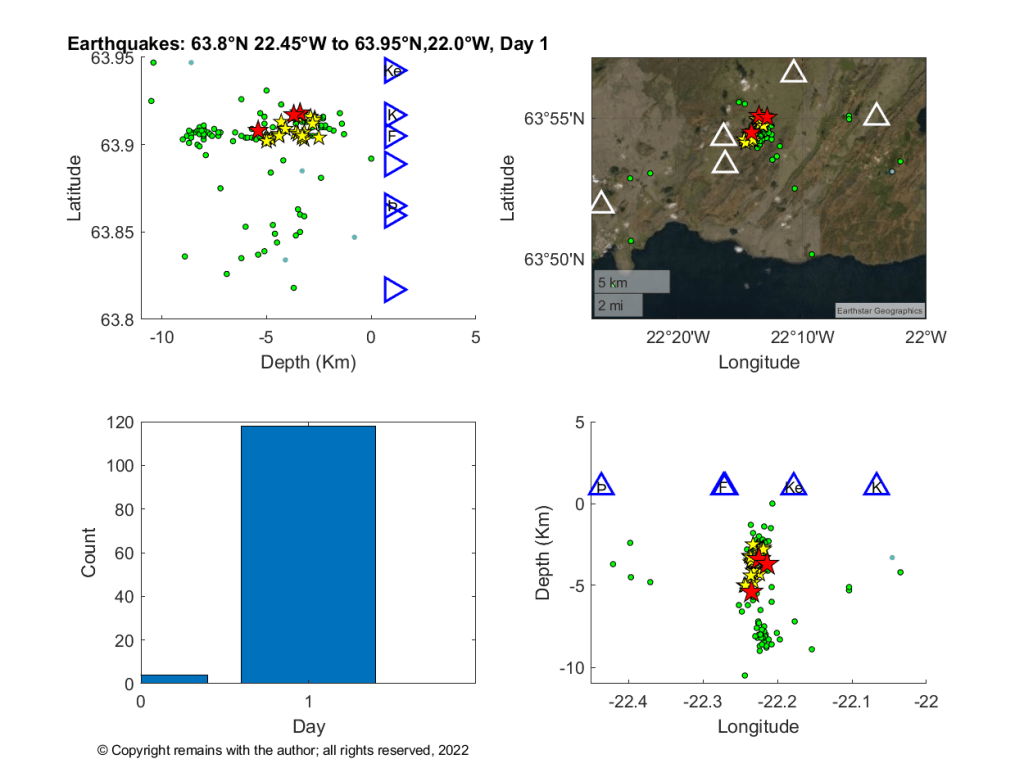
We have downloaded the earthquakes reported from the Table tab and plotted the confirmed  earthquakes (quality 99.9%).

Fig 2:  Earthquake density plot by the author of the swarm.  © Copyright remains with the author; all rights reserved, 2022.
Fig 3a:  Geoscatter, Latitude v Depth and Depth v Longitude plots for day 1 of the swarm by the author.  © Copyright remains with the author; all rights reserved, 2022.
Fig 3b:  Geoscatter, Latitude v Depth and Depth v Longitude plots for day 2 to 11:23 of the swarm by the author.  © Copyright remains with the author; all rights reserved, 2022.

For more up to date information, please consult the Icelandic Met Office, Home-page – Icelandic Meteorological Office | Icelandic Meteorological office (vedur.is)

Armchair Volcanologist

Sources:  in the article.

Updates on Seismicity in the Mount Þorbjörn Area, 17th April 2022 to date

Good Evening!

Update 26th May 2022

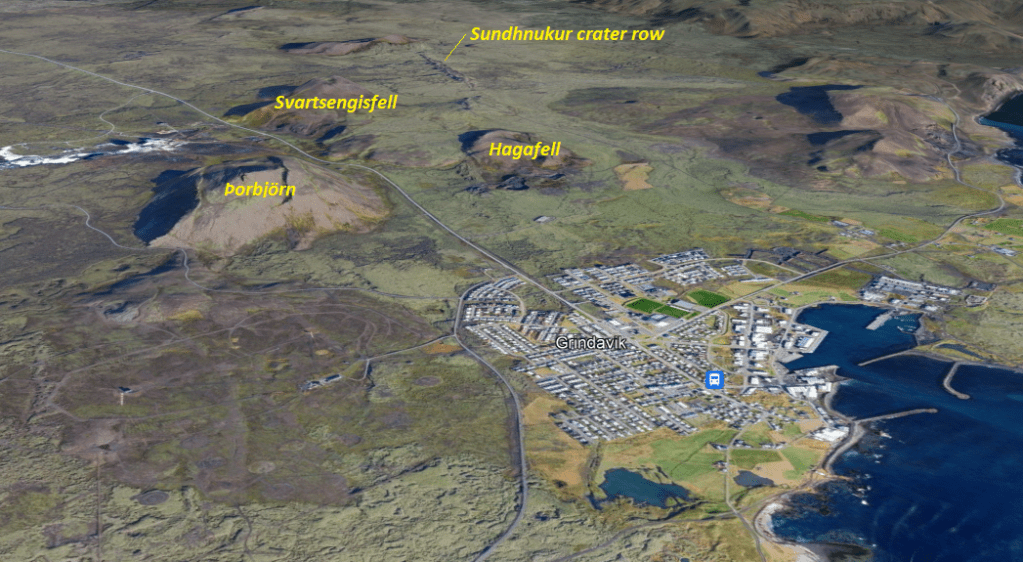
Seismic activity continues in the Svartsengi area, extending to the Sundhnúkur crater row.  The earthquakes in the vicinity of Mount Þorbjörn appear to be getting shallower today as at the time of writing. 

The Sundhnúkur crater row erupted c. 2,360 years ago. It is accredited with creating the Hópsnes/Þórkötlustaðanes land spit to the east of Grindavík.  

Fig 8: Bird’s eye view of the Svartsengi area and Gringavík.  Image from Google Earth; yellow text added by the author.

Here are our updated earthquake plots to 26th May 2022 15:06.

Fig 9: Summaries of Days 39 (25th May 2022) and 40 (26th May 2022) by the author. Grey & green circles denote earthquakes < 3M, yellow stars between 3M and 4M and red stars ≥4M. Blue triangles denote volcanoes: K is Krýsuvík, Ke is Keilir, F is Fagradalsfjall, Ge is Geldingadalir, Þ is Þorbjörn, El is Eldvörp and R is Reykjanes.  © Copyright remains with the author; all rights reserved, 2022.
Fig 10: Earthquake plots depth by day by the author for the area 63.81°N, 22.5°W to 63.90°N 22.35°W from 17th April 2022 (Day 1) to 26th May 2022 (Day 40).  Size denotes magnitude.  © Copyright remains with the author; all rights reserved, 2022.
Fig 11: Geodensity plot of earthquakes by the author for the area 63.81°N, 22.5°W to 63.90°N 22.35°W from 17th April 2022 (Day 1) to 26th May 2022 (Day 40).  © Copyright remains with the author; all rights reserved, 2022.
Fig 12: Latitude v Longitude scatter plot of the area 63.81°N, 22.5°W to 63.90°N 22.35°W from 17th April 2022 to 26th May 2022. Colour indicates age: red, oldest; and, yellow, youngest.  © Copyright remains with the author; all rights reserved, 2022.

The following video shows both the geoscatter plots by day from 17th April 2022 to 26th May 2022 in the swarm for the western Reykjanes Peninsula, and the scatter plots for the same period for the area around Mount Þorbjörn.

Fig 13: Video by the author of the geoscatter plots and scatter plots from which the above images have been extracted. Keys are in the video.  © Copyright remains with the author; all rights reserved, 2022.

While the earthquake plots are highly suggestive of more shallow magma ascent, we need to bear in mind that this area is on the plate boundary, the Mid Atlantic Ridge. Some of the seismic activity may be existing faults moving to accommodate the magma. Time will tell when and where magma emerges.

For the latest updates and alerts, please consult with IMO or the local authorities.

Armchair Volcanologist

Original Post 24th May 2022

The earthquake swarm that started on 17th April 2022 on the western Reykjanes Peninsula continues.  Today we are plotting activity at the Svartsengi area near Mount Þorbjörn, which lies to the north of Grindavík, Iceland. We have used Mount Þorbjörn as the marker for Svartsengi in our plots.

Fig 1: Image cropped from one by Arian Zwegers of the Blue Lagoon looking towards Mount Þorbjörn.  Published under CC-BY SA-2.0.  Source: Þorbjörn (mountain) – Wikipedia

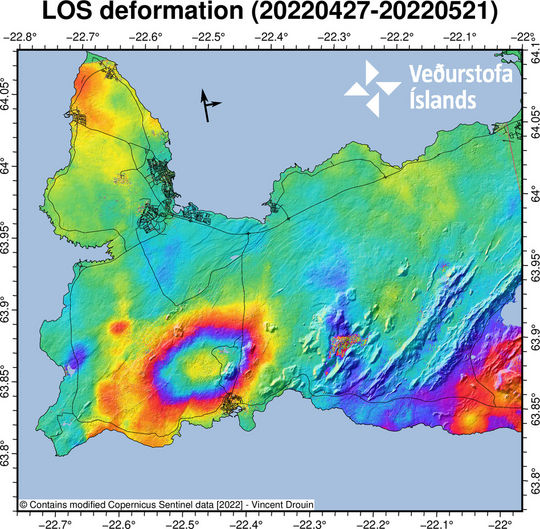
 IMO reports that there has been significant uplift of 40mm to 45mm during the swarm in the area north of Grindavík indicative of magmatic activity.

Fig 2: Ground deformation (Source: IMO, Talsverð skjálftavirkni á Reykjanesskaganum)
Fig 3: Stations in the area showing uplift.  Source for each station: Icelandic Meteorological Office

Let’s look at the earthquakes.

Western Reykjanes Peninsula

Initially, we updated our plots of the area between 63.75°N,23.0°W to 64.0°N, 22°W.  Here is a summary.

Fig 4: Plots by the author of earthquake activity from 17th April 2022 (Day 1) to 24th May 2022 (Day 38) between 63.75°N,23.0°W to 64.0°N, 22°W . Grey & green circles denote earthquakes < 3M, yellow stars between 3M and 4M and red stars ≥4M. Blue triangles denote volcanoes: K is Krýsuvík, Ke is Keilir, F is Fagradalsfjall, Ge is Geldingadalir, Þ is Þorbjörn, El is Eldvörp and R is Reykjanes. Day 38 shows the earthquakes to date in the swarm.  The video below shows the progression of the swarm by day.  © Copyright remains with the author; all rights reserved, 2022.

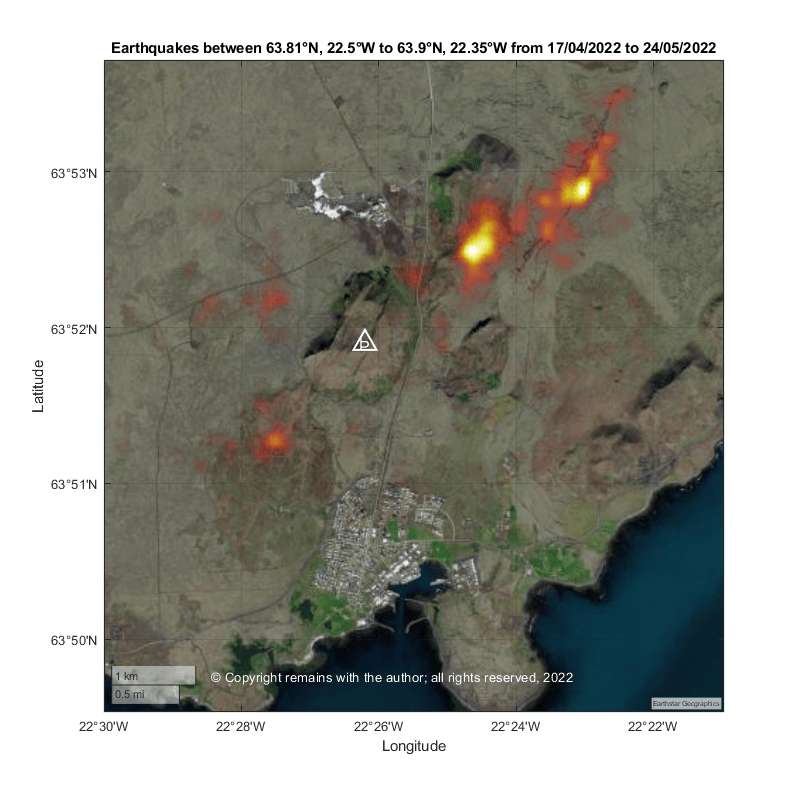
From a simpler scatter plot and a geodensity plot, we can see much of the activity has occurred near Mt Þorbjörn or Svartsengi in the area enclosed in the green box below.
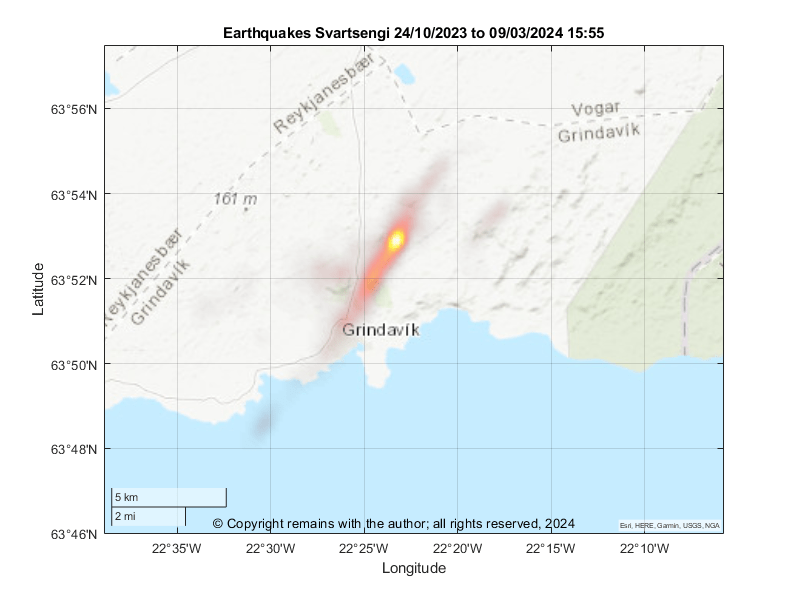
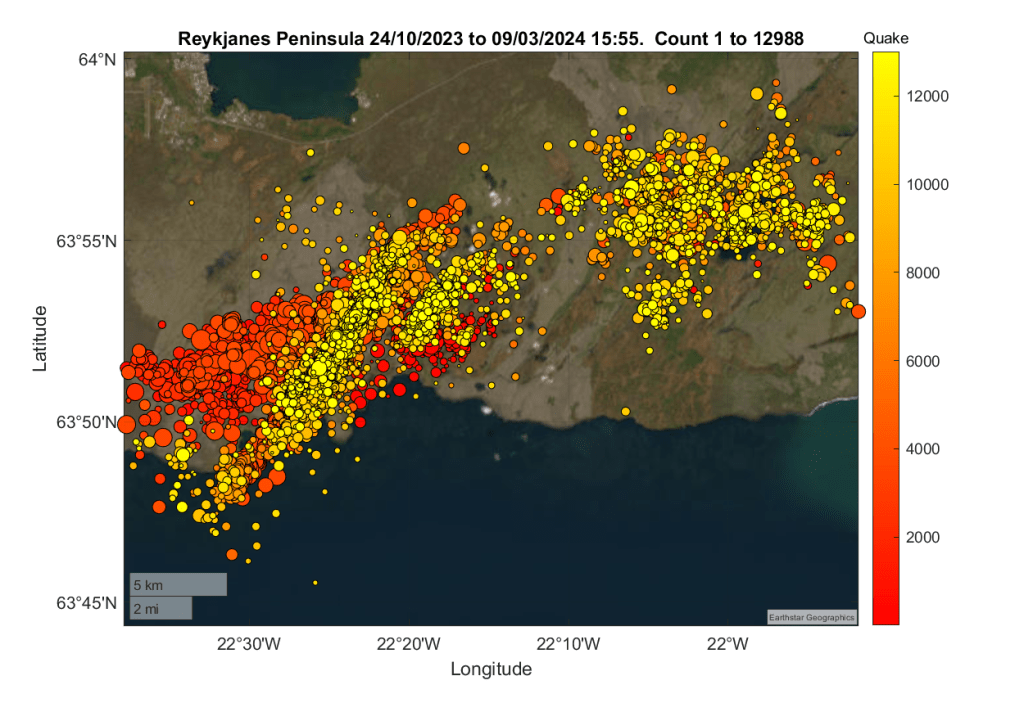
Fig 5a: Latitude v. longitude scatter plot by the author of earthquakes between 63.75N,23W to 64.0N,22W from 17th April 2022 to 24th May 2022. Colour denotes age (red being the oldest and yellow the most recent).  Blue triangles denote volcanoes: K is Krýsuvík, Ke is Keilir, F is Fagradalsfjall, Ge is Geldingadalir, Þ is Þorbjörn, El is Eldvörp and R is Reykjanes. The green square is the area selected for further analysis today (63.81°N, 22.5°W to 63.90°N, 22.35°W). © Copyright remains with the author; all rights reserved, 2022.
 Fig 5b: Geodensity plot by the author of earthquakes between 63.75N,23W to 64.0N,22W from 17th April 2022 to 24th May 2022. © Copyright remains with the author; all rights reserved, 2022.

Let’s look more closely at the area around Mt Þorbjörn.

Svartsengi Area, 63.81°N, 22.5°W to 63.90°N, 22.35°W

Fig 6: Plots by the author of earthquake activity from 17th April 2022 (Day 1) to 24th May 2022 (Day 38). Grey & green circles denote earthquakes < 3M, yellow stars between 3M and 4M and red stars ≥4M. Blue triangle is Þ, Þorbjörn. © Copyright remains with the author; all rights reserved, 2022.
 Fig 7a: Latitude v. longitude scatter plot by the author of earthquakes between 63.81°N, 22.5°W to 63.90°N, 22.35°W from 17th April 2022 to 24th May 2022. Colour denotes age (red being the oldest and yellow the most recent).  Blue triangle is Þ,  Þorbjörn. © Copyright remains with the author; all rights reserved, 2022.
 Fig 7b: Geodensity plot by the author of earthquakes between 63.81°N, 22.5°W to 63.90°N, 22.35°W from 17th April 2022 to 24th May 2022. The Svartsengi geothermal plant and Blue Lagoon are to the north of Þorbjörn and Grindavík is to the south. © Copyright remains with the author; all rights reserved, 2022.

For more up to date information on the seismic activity and the latest alerts, please refer to the local authorities or the Icelandic Met Office, IMO.

Armchair Volcanologist

© Copyright remains with the author; all rights reserved, 2022.

Sources

Raw earthquake data: IMO